
Chronic Pain Statistics in the U.S. 2025: 24 Shocking Trends You Must Know
Most people don’t think about chronic pain until it refuses to go away. It rarely starts as something serious. A small ache lingers, returns more often, and slowly becomes part of daily life. By the time it’s recognized, it’s no longer temporary, it’s persistent, disruptive, and difficult to ignore.
Chronic pain is now one of the most widespread health issues in the United States, affecting tens of millions of people and placing a growing strain on the healthcare system.
The reality is simple, pain that doesn’t go away is becoming increasingly common and the numbers are rising. This 2025 update breaks down the latest statistics, key trends, and what they reveal about where chronic pain is heading.
What Counts as Chronic Pain?
Before looking at the numbers, you need a clear definition.
Chronic pain is pain that lasts three months or longer, it can show up in different ways:
- Continuous (present most days)
- Intermittent but recurring
- Mild, moderate, or severe
There’s also a more serious category, high-impact chronic pain. This is pain that limits daily life, work, movement, or basic self-care.
That distinction matters, a mild, manageable ache is not the same as pain that disrupts your ability to function. The data separates these groups because their impact is completely different.
The Big Number: How Many Americans Have Chronic Pain?
The headline figure is hard to ignore:
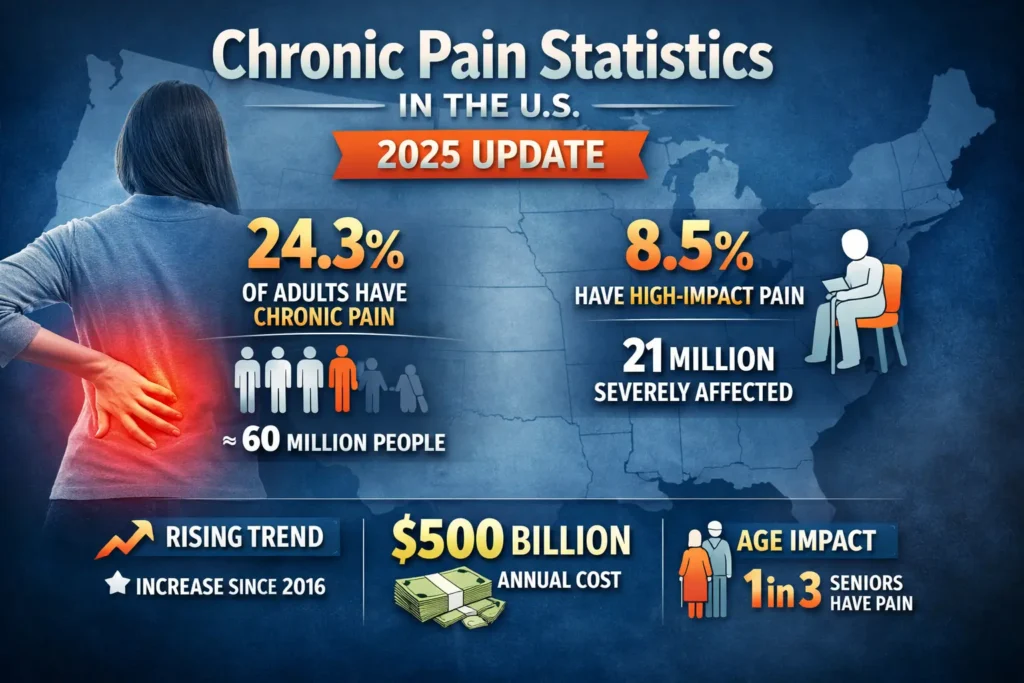
- 24.3% of U.S. adults had chronic pain (2023)
- That’s roughly 60 million people
Put simply:
Nearly 1 in 4 adults in the U.S. lives with chronic pain
Now look at the more severe end:
- 8.5% (about 21 million people) have high-impact chronic pain
These are not minor cases. This is pain that interferes with:
- Working
- Walking or mobility
- Daily routines
This group carries the heaviest burden personally and economically.
A Growing Problem, Not a Stable One
The trend is moving in the wrong direction.
- 2016: 20.4%
- 2021: 20.9%
- 2023: 24.3%
That’s a sharp increase in a short period, this isn’t just better diagnosis. The rise reflects real changes:
- More sedentary lifestyles
- An aging population
- Higher rates of stress and mental health issues
- Workplace and ergonomic problems
The result, more people developing pain that doesn’t resolve.
Age Matters More Than You Think
Chronic pain increases with age, but the pattern is shifting.
Prevalence by age:
- 18-29: 12.3%
- 50-64: 36%+
- 65+: 36%
More than 1 in 3 older adults live with chronic pain
But here’s the key shift, the average age of onset is dropping, with many cases now starting in the mid-30s.
So while older adults have the highest rates, younger adults are entering the system earlier and staying in it longer.
Gender Differences: Women Are Hit Harder
Across multiple datasets, the pattern is consistent:
Women experience chronic pain more often than men
- Women: 25.4%
- Men: 23.2%
The gap widens in specific conditions:
- Fibromyalgia
- Migraine disorders
- Autoimmune diseases
- Endometriosis
This isn’t just biology. It’s also influenced by:
- Hormonal factors
- Delayed diagnosis
- Differences in how symptoms are taken seriously
Socioeconomic and Geographic Inequality
Chronic pain follows social patterns.
Income
- Higher rates among people below the poverty line
- Lower rates among higher-income groups
Location
- Rural areas: higher prevalence
- Urban areas: lower prevalence
Employment
- Higher rates among unemployed or previously employed individuals
Chronic pain is not just a medical issue. It’s tied to access, environment, and opportunity. People with fewer resources face higher risk and fewer treatment options.
Racial and Ethnic Disparities
Prevalence varies across groups:
- American Indian/Alaska Native: 30.7%
- White (non-Hispanic): 26-27%
- Hispanic: 17-25%
- Asian: 9-12%
These differences are not random. They reflect:
- Access to healthcare
- Type of work (physical vs sedentary)
- Cultural and systemic factors
Chronic pain follows structural patterns, not just individual health.
Chronic Pain and Mental Health: A Reinforcing Loop
Pain and mental health are tightly linked.
- About 12 million U.S. adults have both chronic pain and anxiety or depression
- Nearly 1 in 4 people with chronic pain experience significant mental health symptoms
This creates a cycle:
Pain → stress → anxiety/depression → increased pain sensitivity → worse pain
Breaking this loop is difficult, which is why many cases become long-term.
Economic Cost: A $500 Billion Problem
Chronic pain is one of the most expensive health issues in the U.S.
- Estimated annual cost: over $500 billion
This includes:
- Medical care
- Lost productivity
- Disability and workforce exit
The total cost exceeds cancer, heart disease, and diabetes combined, that’s not just a healthcare problem, it’s an economic one.
The High-Impact Group: Where the Real Burden Lies
While about 1 in 4 Americans has chronic pain, a smaller group carries most of the burden.
- 8.5% of adults have high-impact chronic pain
This is pain that disrupts daily function. People in this group often face:
- Limited mobility
- Reduced ability to work
- Loss of independence
- Frequent healthcare use
They account for a disproportionate share of:
- Disability claims
- Healthcare spending
- Long-term complications
If you want to understand the real weight of chronic pain, this is the group to focus on.
Treatment Gap: Many People Still Go Untreated
Despite how common chronic pain is, care is inconsistent.
- Nearly 21% of people with severe chronic pain received no treatment for at least 3 months
That’s not a minor gap. It points to a system that isn’t reaching a large portion of those who need help.
Key barriers include:
- Cost and insurance limitations
- Limited access to specialists
- Concerns about medication risks
- Misdiagnosis or symptoms being dismissed
The result is delayed care, worsening symptoms, and more complex cases over time.
The Shift Away from Opioids
Chronic pain treatment has changed significantly. In the past, opioids were widely used, today, the approach is broader and more cautious.
Current strategies focus on:
- Physical therapy
- Behavioral and psychological support
- Lifestyle changes
- Non-opioid medications
This shift is necessary, but it has created a gap. Some patients are now caught between reduced access to older treatments and limited availability of newer, comprehensive care.
Chronic Pain and the Opioid Crisis
Chronic pain and opioid use are closely linked.
Chronic pain:
- Is a major reason opioids are prescribed
- Increases the risk of long-term use
- Raises the risk of dependence when poorly managed
But reducing prescriptions alone doesn’t solve the problem. The core issue is lack of effective, well-rounded pain management.
Without alternatives, patients are left with fewer options, not better care.
Chronic Pain Is Becoming a Younger Person’s Problem
A key shift is happening, chronic pain is no longer limited to older adults
Recent trends show:
- More cases in working-age adults
- Increase in posture and screen-related pain
- Earlier onset linked to inactivity
Office and tech-based work is a major factor. Long hours of sitting, poor ergonomics, and low physical activity are contributing to new cases.
This has long-term consequences:
- More years living with pain
- Higher lifetime healthcare costs
- Reduced productivity over time
The Role of Lifestyle in Chronic Pain
Modern lifestyle patterns are directly tied to rising pain rates.
Sedentary behavior
- Prolonged sitting
- Poor posture
- Low physical activity
1. Obesity
- Increased strain on joints
- Chronic inflammation
2. Sleep disruption
- Poor recovery
- Increased pain sensitivity
3. Stress
- Amplifies how pain is perceived
- Alters nervous system responses
These factors don’t just contribute, they actively drive the trend.
Chronic Pain vs Other Chronic Diseases
Chronic pain is often underestimated. It affects more people than many major conditions, including:
- Diabetes
- Depression
- Hypertension
Yet it receives less structured attention and fewer coordinated care strategies. That gap matters, because prevalence alone should make it a top priority.
Why Chronic Pain Is So Hard to Treat
Chronic pain isn’t just a physical issue.
It involves:
- Changes in the nervous system
- Psychological factors
- Social and environmental influences
Because of this, it is:
- Difficult to diagnose precisely
- Hard to measure objectively
- Challenging to treat with a single approach
There is no universal cure, most patients require long-term management across multiple areas.
The Future: Where the Trends Are Heading
If current patterns continue, several outcomes are likely:
1. Rising prevalence
More people developing chronic pain earlier in life
2. Increasing economic burden
Costs continuing to grow beyond current levels
3. Greater reliance on non-drug therapies
More emphasis on rehabilitation and behavioral care
4. More personalized treatment
Use of data and individualized plans to manage pain more effectively
Key Takeaways (2025 Snapshot)
- 1 in 4 U.S. adults (24.3%) has chronic pain
- Around 60 million people are affected
- 21 million have high-impact, disabling pain
- Rates are increasing
- Women, older adults, and lower-income groups are most affected
- Annual cost exceeds $500 billion
- Millions still do not receive adequate treatment
Final Thoughts
Chronic pain is not just a symptom. It’s a long-term condition that affects how people live, work, and function.
The trend is clear:
This problem is growing, not stabilizing, without better prevention, earlier intervention, and improved access to care, the next set of data won’t just show higher numbers, it will reflect a deeper, more entrenched public health issue.
Must Read:
- 7 Proven Ways to Relieve Back Pain During Ovulation Naturally
- Period Pain Worse Some Months: 9 Shocking Reasons Your Cramps Change
- 10 Powerful Reasons a Child Complains of Leg Pain + When to See a Doctor
- Neck Pain From Poor Posture: Can It Cause Permanent Damage? 11 Expert Insights
- Neck Pain From Sleeping Position or Pillow Choice: 13 Proven Solutions for Morning Pain Relief
- Best Back and Joint Pain Relief Devices You Can Use at Home: 17 Doctor‑Approved Solutions That Work
- 7 Back or Joint Pain Red Flags You Shouldn’t Ignore

Dr. Ijasusi Bamidele, MBBS (Binzhou Medical University, China), is a medical doctor with 5 years of clinical experience and founder of MyMedicalMuse.com, a subsidiary of Delimann Limited. As a health content writer for audiences in the USA, Canada, and Europe, Dr. Ijasusi helps readers understand complex health conditions, recognize why they have certain symptoms, and apply practical lifestyle modifications to improve well-being