⚠️ Affiliate Disclaimer: This post may contain affiliate links, which means I may earn a small commission at no extra cost to you, if you make a purchase through one of these links. I only recommend products or services I genuinely trust and believe can provide value. Thank you for supporting My Medical Muse!
Sleep Deprivation Statistics: How Common Is It?
Sleep is one of the most fundamental needs of the human body. Yet, despite its critical role in health, productivity, and overall well-being, it is increasingly neglected in modern life. Across countries, age groups, and lifestyles, data consistently points to a growing problem, people are sleeping less, and the consequences are piling up.
This is more than just an occasional feeling of fatigue, chronic sleep deprivation is a measurable global health issue, contributing to mental health challenges, chronic diseases, impaired cognitive performance, and significant economic losses.
Understanding how common it is and the factors driving it is essential if we hope to address the problem before it worsens.
In this article, we will explore the latest statistics, analyze trends by age group and region, examine the hidden drivers behind sleep deprivation, and discuss its serious consequences for physical, mental, and societal health.
The Big Picture: How Widespread Is Sleep Deprivation?
If you think sleep deprivation is rare or limited to a few overworked individuals, the statistics tell a much different story.
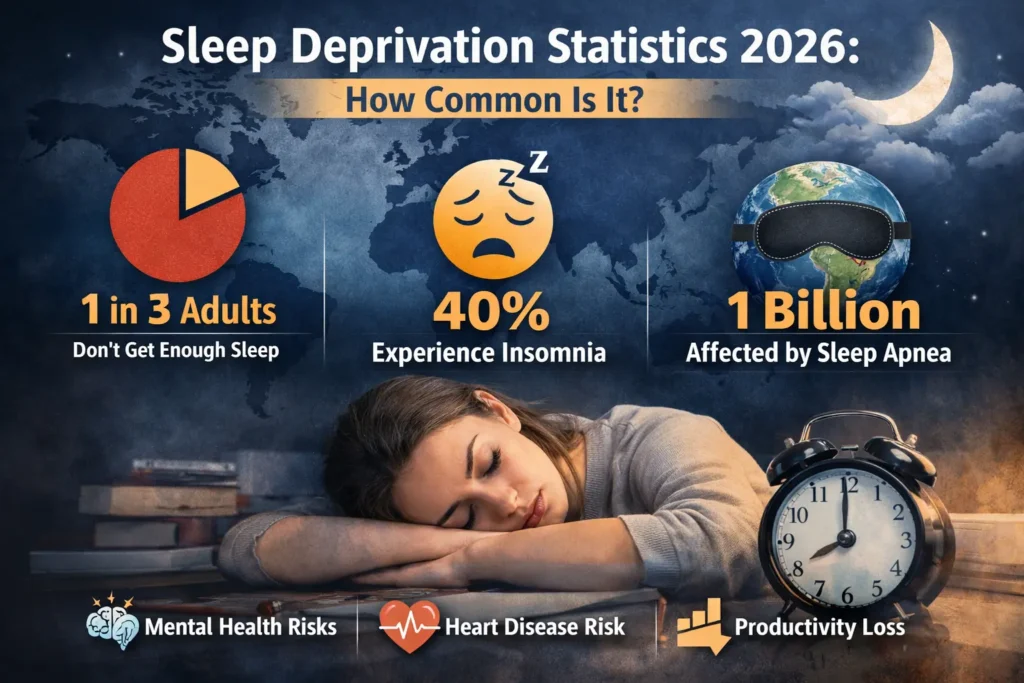
Globally, up to 40% of the population experiences some form of sleep disorder at some point in life. Conditions such as insomnia, sleep apnea, and restless leg syndrome affect millions, often going undiagnosed. Meanwhile, approximately one-third of adults do not get enough sleep on a regular basis, and nearly the same proportion report experiencing insomnia symptoms.
Sleep deprivation is not just a minor inconvenience, it is increasingly the norm. It spans continents, socioeconomic levels, and lifestyles. Whether in the United States, Europe, Asia, or the Middle East, a significant portion of populations consistently fails to achieve the recommended 7-9 hours of sleep per night.
Global Sleep Trends
Studies show striking global differences in sleep habits, but the overall pattern is clear: people are sleeping less than ever before. For example:
- In the U.S., nearly 35% of adults report consistently sleeping less than 7 hours per night.
- In European countries such as Germany and the UK, surveys indicate that 25-30% of adults are chronically sleep-deprived.
- In Asian megacities like Tokyo, Seoul, and Beijing, cultural pressures, long work hours, and late-night commutes contribute to sleep deprivation in upwards of 40% of working adults.
Even in regions with strong awareness about health and lifestyle balance, sleep deprivation remains pervasive. This suggests that the problem is systemic, influenced not just by individual habits but by societal norms, work culture, and technological change.
Adults: A Growing Sleep Deficit
Among adults, sleep deprivation is both common and persistent. The implications are profound because adult sleep patterns are closely linked to health, productivity, and long-term disease risk.
Key Statistics
- More than 1 in 3 adults do not meet recommended sleep duration, which is 7-9 hours per night.
- Adults who sleep 6 hours or less are 2.5 times more likely to experience frequent mental distress, including anxiety and depression.
- Older adults (65+) show a 40-50% prevalence of sleep disorders, including insomnia and sleep apnea, which can exacerbate age-related cognitive decline.
Socioeconomic factors also play a significant role. People in lower-income brackets or high-stress professions are more likely to experience chronic sleep deprivation, often due to work schedules, financial pressures, or multiple jobs. Night shift workers, for example, face disrupted circadian rhythms, making it difficult to achieve restorative sleep.
Modern adult life, long hours, digital distractions, and constant connectivity creates an environment where sleep is increasingly sacrificed. Work culture glorifies productivity and long hours, often at the expense of basic biological needs, making chronic sleep deprivation almost inevitable for many.
Teenagers and Young Adults: The Most Affected Group
If adults are losing sleep, teenagers and young adults are in an even more precarious situation.
Why Teens Sleep Less
Adolescents have unique biological needs, requiring 8-10 hours of sleep per night for optimal physical and cognitive development. Yet, the pressures of modern life mean that many are getting far less.
- In some populations, over 60% of adolescents experience sleep deprivation, often going to school tired and struggling with focus.
- In certain regions, 1 in 5 teenagers is clinically sleep-deprived, meaning their lack of sleep reaches levels that can cause long-term health effects.
- Sleep loss in teens is strongly linked to mental health problems, including depression, anxiety, mood swings, and impaired academic performance.
Several factors drive sleep deprivation in youth:
- Late-night screen use: Phones, tablets, and computers expose teens to blue light, which disrupts melatonin production and delays sleep onset.
- Academic pressure: Homework, extracurricular activities, and preparation for standardized tests often push bedtime later.
- Irregular sleep schedules: Weekends and late-night socializing can create a “social jetlag,” confusing the body’s circadian rhythm.
- Social media and digital overstimulation: Constant notifications, social comparison, and engagement with online content interfere with natural sleep patterns.
The result is a population of young people who are biologically wired for more sleep but consistently denied it. This not only affects day-to-day functioning but can have lasting consequences on learning, emotional regulation, and physical health.
Sleep Disorders: The Hidden Drivers
Sleep deprivation is not always simply a matter of staying up late or poor habits. In many cases, it is driven by underlying medical conditions.
Major Sleep Disorders
- Insomnia affects 10-30% of the global population, making it the most common sleep disorder. Chronic insomnia can persist for months or years, significantly reducing overall quality of life.
- Obstructive sleep apnea (OSA) impacts around 1 billion adults worldwide. This condition causes repeated interruptions in breathing during sleep, leading to fragmented rest, daytime fatigue, and higher cardiovascular risk.
- Restless leg syndrome (RLS) affects 5-10% of people globally, causing uncomfortable sensations in the legs that disrupt sleep.
Many of these disorders go undiagnosed, leaving millions chronically sleep-deprived without realizing the cause. Early recognition and treatment of sleep disorders are essential to reversing chronic sleep deficits and reducing associated health risks.
Lifestyle and Environmental Factors
Beyond medical conditions, lifestyle and environmental factors play a major role in modern sleep deprivation.
1. Technology and Screen Time
Exposure to screens in the evening disrupts circadian rhythms, delays melatonin production, and keeps the brain in an alert state. Teenagers and adults alike are increasingly affected, with many using devices right before bed.
2. Work Culture
Shift workers, who make up a significant portion of the global labor force, face sleep disorder prevalence of 25% or more, much higher than average. Night shifts, irregular hours, and high-stress work environments interfere with natural sleep patterns.
3. Climate and Environment
Recent research shows that rising global temperatures negatively affect sleep quality. Hotter nights increase awakenings, reduce slow-wave sleep, and exacerbate sleep disturbances, adding an environmental layer to this public health issue.
4. Urbanization and Stress
High-density urban environments, noise pollution, constant stimulation, and stress all contribute to reduced sleep quality. People in metropolitan areas are often sleeping less than rural populations, demonstrating that sleep deprivation is also shaped by surroundings, not just individual habits.
The Health Impact: Why Sleep Deprivation Matters
Sleep deprivation is more than just an inconvenience, it has serious implications for health, safety, and productivity.
Physical Health Consequences
- Increases risk of heart disease by up to 50%.
- Raises likelihood of obesity, diabetes, and hypertension.
- Weakens the immune system, making the body more vulnerable to infections.
Mental Health Consequences
- Doubles the risk of developing depression and anxiety.
- Impairs cognitive function, including memory, attention, and decision-making.
- Contributes to emotional instability and lower resilience to stress.
Productivity and Economic Impact
- Chronic sleep deprivation reduces workplace performance, increases errors, and elevates accident risk.
- Studies estimate that sleep loss costs hundreds of billions of dollars annually in lost productivity worldwide.
- For students, sleep deprivation reduces academic performance, impacting learning and long-term career prospects.
In essence, the health and economic costs of sleep deprivation affect not only individuals but entire communities and economies.
A Silent Epidemic
What makes sleep deprivation particularly dangerous is its subtlety. Unlike acute illness, it often goes unnoticed until serious consequences emerge.
- People adapt to chronic tiredness, normalizing fatigue.
- Cognitive function may decline gradually, making it hard to recognize the extent of impairment.
- Over time, sleep deprivation compounds, leading to serious health outcomes, accidents, and mental health issues.
Millions of people are affected globally. Entire age groups, adolescents, adults, and older adults are experiencing insufficient sleep. And the trend is worsening, with modern lifestyles making it increasingly difficult to achieve the recommended sleep duration.
Societal Implications
Sleep deprivation isn’t just an individual problem; it’s a societal challenge. Governments, employers, and healthcare systems face the consequences.
- Healthcare systems bear higher costs due to increased chronic disease burden.
- Road safety is compromised, with drowsy driving contributing to thousands of accidents annually.
- Workplaces experience lower productivity and higher error rates.
Addressing sleep deprivation requires more than personal effort, it requires structural change: flexible work schedules, public education about sleep hygiene, and clinical recognition of sleep disorders.
Tips to Combat Sleep Deprivation
While statistics may seem daunting, sleep deprivation is preventable and manageable with practical strategies:
- Prioritize Sleep: Treat sleep as non-negotiable, not optional.
- Maintain a Consistent Schedule: Go to bed and wake up at the same time daily, even on weekends.
- Limit Screen Time Before Bed: Avoid devices at least 1 hour before sleep.
- Create a Sleep-Friendly Environment: Dark, cool, and quiet rooms support restorative sleep.
- Address Medical Conditions: Consult healthcare providers for sleep disorders such as insomnia or sleep apnea.
- Reduce Stimulants and Alcohol: Limit caffeine and alcohol close to bedtime, as they disrupt natural sleep cycles.
Implementing these strategies can improve sleep quality, mental health, and overall life satisfaction.
Final Thoughts
Sleep deprivation is no longer just a personal inconvenience, it is a global public health issue. When one-third of adults do not get enough sleep, and adolescents experience even higher rates of sleep loss, it is clear that this is not a matter of individual laziness.
Modern life, with its long work hours, constant connectivity, and environmental pressures, has created a culture where sleep is undervalued. The consequences ranging from increased disease risk to reduced productivity are profound.
The takeaway is simple: sleep is foundational, it affects our physical health, mental resilience, cognitive function, and ability to thrive in daily life. Ignoring the problem only makes it worse, while addressing it can dramatically improve well-being and societal outcomes.
In 2026, the data makes one thing clear: far more people are missing out on restorative sleep than most realize. Recognizing sleep deprivation as a serious, widespread problem is the first step toward change, for individuals, communities, and nations.
👩⚕️ Need Personalized Health Advice?
Get expert guidance tailored to your unique health concerns through MuseCare Consult. Our licensed doctors are here to help you understand your symptoms, medications, and lab results—confidentially and affordably.
👉 Book a MuseCare Consult NowRelated Blog Post:
- 10 Proven Ways Sleep Triggers Chronic Headaches (And How to Fix Them)
- 7 Shocking Reasons Why Sleeping Immediately After Eating Can Harm Your Health
- Is Sleeping with the Light On Bad for You? 7 Hidden Health Risks Explained
- Sleeping with AC or Heater: 7 Powerful Health Truths You Must Know
- Why Caffeine Makes You Sleepy Instead of Alert: 8 Surprising Reasons
- 7 Proven Fixes for Neck Stiffness After Sleeping Wrong

Dr. Ijasusi Bamidele, MBBS (Binzhou Medical University, China), is a medical doctor with 5 years of clinical experience and founder of MyMedicalMuse.com, a subsidiary of Delimann Limited. As a health content writer for audiences in the USA, Canada, and Europe, Dr. Ijasusi helps readers understand complex health conditions, recognize why they have certain symptoms, and apply practical lifestyle modifications to improve well-being