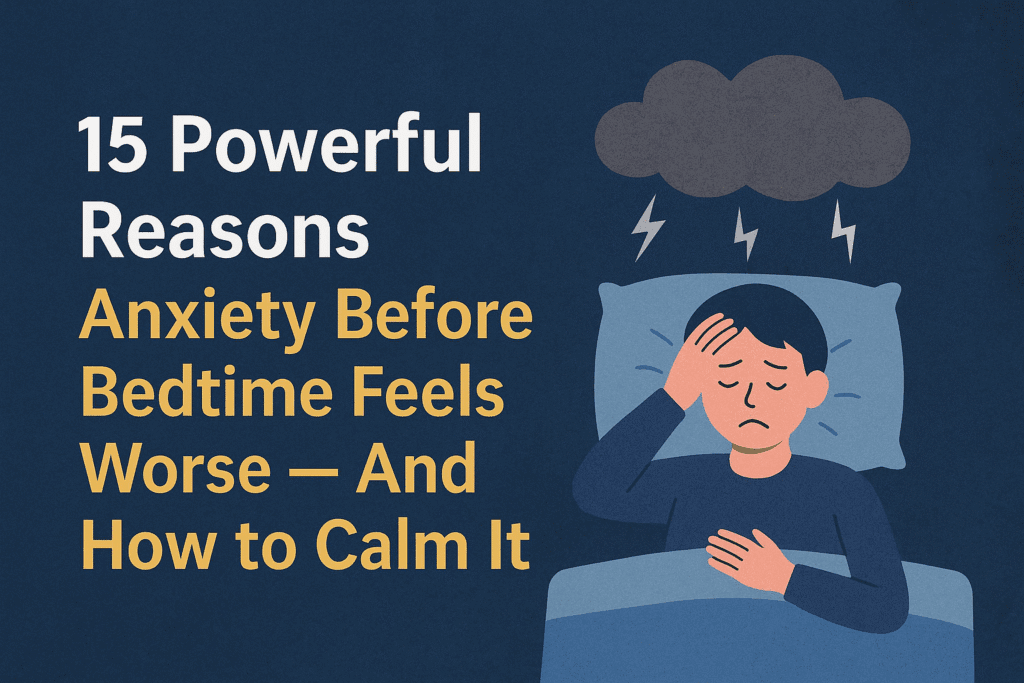
15 Powerful Reasons Anxiety Before Bedtime Feels Worse
Most people imagine nighttime as the one sanctuary where everything finally slows down, the lights dim, the world quiets, and your mind is supposed to follow but for countless people, the moment their head touches the pillow is when everything inside speeds up. You can move through an entire day appearing steady and composed, managing responsibilities, thinking clearly, and keeping yourself together, only to lie down in the dark and feel your heart kick into overdrive, your breathing tighten and your thoughts race with a force that feels completely out of proportion.
If this sounds familiar, you’re far from alone and no, it’s not “just in your head.” There are real biological rhythms, psychological patterns and environmental conditions that make nighttime the perfect amplifier for anxiety. In the quiet, your mind finally has the space to unload everything it held back during the day. Your brain shifts into deeper internal processing, your emotions gain clarity and your nervous system tries to recalibrate all at once.
This guide unpacks the science behind why anxiety often surges after dark, explores the hidden patterns that shape your nighttime experience and breaks down the subtle triggers that can turn an ordinary evening into a mental battleground. Most importantly, it offers strategies to help you reclaim your nights, steady your thoughts and rebuild a sense of safety when you need it most.
1. Your Brain Finally Has Space to Process What You’ve Ignored All Day
During the day, your brain is flooded with distractions, work tasks, errands, conversations, social media, responsibilities, noise and a stream of micro-stimuli that constantly occupy your attention.
This creates a natural emotional buffer that suppresses anxious thoughts simply because there isn’t enough mental bandwidth to process them.
At night, that buffer disappears when you lie down in a dark, quiet room, there are no external distractions competing for mental energy. The brain automatically shifts toward internal processing. Thoughts you pushed aside all day, worries, fears, incomplete tasks, emotional discomfort begin to surface.
This is why:
- small concerns suddenly feel huge
- hypothetical scenarios become vivid
- your mind replays the day or imagines the worst-case future
- intrusive thoughts appear out of nowhere
You’re not “becoming more anxious” at night your brain is just finally unmasking what you suppressed earlier.
2. The Brain’s Default Mode Network Becomes More Active at Night
Neuroscientists have identified a system in the brain called the Default Mode Network (DMN), the network responsible for self-reflection, mental chatter, memories and internal storytelling.
The DMN becomes more active when:
- you’re not engaged in a task
- you’re resting
- you’re lying down
- you’re preparing for sleep
In short: bedtime activates the part of your brain that loves to wander, analyze, remember and imagine the exact functions that feed anxiety. If you tend to overthink, ruminate or worry about the future, the DMN is essentially the “engine” behind those thought patterns. The quieter your environment, the louder that engine runs.
3. Cortisol Doesn’t Always Drop at Night Especially If You’re Stressed
Cortisol, the body’s stress hormone, follows a natural cycle:
- low at night
- high in the morning
This “diurnal cortisol rhythm” prepares you for sleep and then wakes you up in the morning but chronic stress, trauma, burnout, grief and even mild anxiety can disrupt this cycle.
When cortisol stays elevated into the evening, you may experience:
- racing heart
- wired-but-tired feeling
- inability to relax
- restlessness
- shallow breathing
- chest tightness
- sudden panic when trying to fall asleep
A dysregulated nervous system doesn’t automatically switch off just because it’s nighttime.
4. Melatonin Rises and That Quietness Can Feel Emotionally Intense
Melatonin does more than regulate sleep, it influences emotional perception.
As melatonin increases at night:
- sensory input decreases
- emotional awareness increases
- internal thoughts become more vivid
- emotional memory becomes more accessible
This means nighttime naturally makes you feel things more deeply. If you already have underlying anxiety, melatonin’s emotional intensification can make that anxiety feel sharper.
It’s similar to how feelings often hit harder during:
- late-night conversations
- quiet moments on the couch
- long drives with no distractions
Night makes emotions louder. It’s not just you, it’s biology.
5. The Body Enters “Energy Conservation Mode” Which Makes You More Aware of Sensations
During relaxation, the sympathetic nervous system (fight-or-flight) should quiet down, and the parasympathetic system (rest-and-digest) should take over, but if your sympathetic system is stuck in a heightened state which is common in people with anxiety, the shift toward stillness reveals symptoms you didn’t notice earlier.
When you lie still at night, you become hyperaware of:
- heartbeats
- breathing rate
- stomach tension
- muscle tightness
- temperature
- tingling sensations
Your brain interprets these sensations as “something is wrong” triggering more anxiety.
This is why:
- your heartbeat feels louder in bed
- you suddenly notice every tiny body symptom
- small shifts in breathing feel dramatic
Stillness exaggerates physical awareness and anxiety thrives in that space.
6. Anticipatory Anxiety Peaks at Night
Humans naturally anticipate the next day as night approaches.
For people with anxiety, this turns into:
- fear of tasks
- fear of conversations
- fear of deadlines
- fear of failure
- fear of embarrassment
- fear of pain or health issues
- fear of not sleeping
This last one, the fear of not sleeping is a major trigger.Once your brain associates bedtime with dread, a cycle forms:
Anxiety at night → poor sleep → exhaustion → more anxiety → even worse nights
This cycle can spiral quickly unless interrupted.
7. Nighttime equals Less Control, and Anxiety Hates That
During the day, you have tools to regain a sense of control:
- action
- movement
- conversations
- distractions
- problem-solving
- food
- sunlight
- social interaction
Night removes all of these. You can’t fix anything at midnight. You can’t call people. You can’t run errands. You can’t solve tomorrow’s problems. Your brain interprets this lack of control as a threat.
Night is essentially a “forced vulnerability” and anxious brains react poorly to that.
8. Your Brain Naturally Reviews the Day, Sometimes Harshly
Before sleep, the brain enters a memory consolidation phase.
This encourages:
- replaying memories
- analyzing conversations
- criticizing past actions
- replaying mistakes
- imagining alternative outcomes
If you have perfectionistic tendencies, unresolved conflict, social anxiety, high self-expectations or a history of emotional sensitivity, this nighttime review can feel brutal.
This is why people often find themselves thinking:
- Why did I say that today?
- What if that person misunderstood me?
- I should have done better.
- I probably embarrassed myself.
Night gives your inner critic the microphone.
9. Blue Light, Caffeine and Late Eating All Increase Night Anxiety
Your physiology plays a bigger role than you think.
Blue light delays melatonin release and overstimulates the brain. Caffeine (even 7-10 hours earlier) can stay in your system long enough to trigger nighttime:
palpitations
- restlessness
- overstimulation
- racing thoughts
Late meals especially high-carb or high-fat foods, increase:
- heart rate
- body temperature
- metabolic activity
Combine all three, and the brain becomes too alert to transition into deep rest.
10. Bedtime Is When Unresolved Emotions Resurface
If you’ve been carrying emotional stress, grief, anger, disappointment, heartbreak, loneliness, guilt or shame, bedtime is when your emotional brain demands attention. Night has a way of pulling unresolved emotions to the surface, especially the ones you didn’t have time to feel during the day.
This creates:
- tightness in the chest
- heaviness in the stomach
- sudden tears
- waves of sadness
- anxiety out of nowhere
You’re not falling apart, your emotional system is trying to catch up.
11. Poor Sleep History Can Condition Your Brain to Expect Anxiety at Night
If you’ve had multiple nights of bad sleep, panic attacks or racing thoughts, your brain can form a negative association with bedtime.
This is classical conditioning:
Bed equals anxiety
Bed equals fear
Bed equals racing thoughts
Even if nothing is wrong, your brain triggers anxiety because it remembers the last time. This becomes a self-reinforcing loop unless intentionally broken.
12. Hormone Fluctuations Intensify Nighttime Anxiety
Hormones that influence mood and anxiety including estrogen, progesterone, cortisol, adrenaline and norepinephrine fluctuate throughout the evening.
This can make nighttime anxiety worse for:
- people with PMS or PMDD
- perimenopause or menopause
- thyroid disorders
- blood sugar imbalances
- irregular sleep patterns
- chronic stress
Hormones influence emotional regulation more than people realize.
13. Sleep Deprivation Itself Makes Anxiety Worse, Which Makes Sleep Even Harder
Poor sleep disrupts:
- GABA (calming neurotransmitter)
- serotonin
- cortisol regulation
- emotional processing
- nervous system balance
After one bad night, the anxiety center of the brain, the amygdala becomes 60% more reactive to stress the next day.
This makes nighttime anxiety even worse the following evening, creating a vicious cycle.
14. Your Imagination Is More Active at Night and Anxiety Loves Imagination
The brain becomes more imaginative, creative, and symbolic in low-light environments.
This is why nighttime enhances:
- catastrophic thinking
- exaggerated fears
- intrusive thoughts
- worst-case scenarios
- fear of death or illness
- irrational predictions
Your imagination isn’t the problem but anxiety uses it against you in the dark.
15. Loneliness and Social Isolation Feel Stronger at Night
Even if you were around people all day, night has a way of highlighting emotional emptiness. Humans are social creatures, and isolation naturally triggers the threat response system. That loneliness becomes fertile ground for anxiety.
People often experience:
- longing
- fear of abandonment
- replaying old relationships
- worrying about being misunderstood
- overthinking social interactions
- fear of the future
The brain processes relational pain more intensely at night.
So What Can You Do About Nighttime Anxiety?
Nighttime anxiety doesn’t disappear by force, it shifts when your brain begins to experience evenings as predictable, safe, and calm. The strategies below are grounded in neuroscience and behavioral psychology and they consistently help people retrain their nervous systems over time.
1. Set a “Thought Cut-Off Time”
About an hour before bed, draw a firm boundary around mentally stimulating activities. This is the point where you intentionally stop:
- problem-solving
- planning
- worrying
- checking messages
- responding to emails
- engaging in anything emotionally or mentally demanding
Your brain needs a clear transition from “doing mode” to “rest mode.” Without this break, it stays on the same high-alert loop it used all day. If your mind keeps trying to hold onto tasks or concerns, write them down in a notebook. This externalizes the worry and tells your brain:
“This has been captured. It will be dealt with tomorrow.”
That reassurance alone decreases mental load and reduces the nighttime spike in rumination.
2. Create a Pre-Sleep Ritual That Calms the Nervous System
A predictable nighttime routine doesn’t just feel nice, it conditions your brain to associate certain actions with safety and relaxation. These activities lower heart rate, reduce cortisol and activate the parasympathetic nervous system:
- warm shower to relax muscles
- dim lighting to signal melatonin release
- slow stretching to loosen stored tension
- soft music with a steady rhythm
- journaling to clear mental clutter
- meditation or mindfulness practice
- herbal tea (like chamomile or lemon balm)
- reading something light or neutral
When done consistently, your brain begins to interpret this routine as a cue:
“We’re safe. We’re winding down”
That shift alone can dramatically ease nighttime anxiety.
3. Keep Devices Out of the Last Hour Before Bed
Blue light from phones and screens blocks melatonin production, keeping your brain in daytime mode long after sunset but it’s not just the light, the content itself is overstimulating.
Scrolling:
- activates the Default Mode Network
- triggers comparison anxiety
- introduces new stressors
- spikes dopamine
- delays emotional unwinding
Keep devices away for the last hour before sleep. Turn your phone off, switch to airplane mode, or leave it across the room where you can’t reach it without getting up.Your brain needs digital silence to settle.
4. Use Controlled Breathing
Breathing is the fastest way to interrupt fight-or-flight activation. Slow, deliberate breathing lowers heart rate, reduces blood pressure and calms the amygdala, the part of the brain that triggers anxiety. Two reliable techniques:
Physiological Sigh
- inhale fully
- take a second small inhale on top of it
- exhale slowly and completely
This mimics the body’s natural panic-reset mechanism.
4-7-8 Breathing
- inhale for 4 seconds
- hold for 7 seconds
- exhale for 8 seconds
The long exhale shifts your nervous system into relaxation mode within minutes.
5. Stay Out of Bed Until You’re Actually Sleepy
If your brain has learned to associate your bed with anxiety, lying there awake only reinforces that pattern. Sleep specialists recommend breaking the negative association by using your bed only for sleep.
If you’re not sleepy yet:
- sit in another room
- keep lights soft and warm
- read something calming
- engage in low-stimulation activity
Return to bed only when your eyelids feel heavy. This trains your brain to link your bed with sleep instead of worry.
6. Reduce Stimulants After 2 PM
Even if you don’t “feel” caffeine, your nervous system absolutely does and it stays in your system far longer than most people realize.
Avoid late-day:
- coffee
- energy drinks
- chocolate
- black tea or green tea
- pre-workout supplements
Stimulants elevate heart rate, disrupt melatonin, and create internal restlessness that becomes far more noticeable at night.
7. Eat Your Last Meal 3-4 Hours Before Bed
Digesting food increases your heart rate and body temperature two things that directly interfere with natural sleep onset.
When you finish eating earlier:
- your system stabilizes
- your heart rate drops
- your core temperature decreases
- your nervous system shifts toward rest
This creates the physiological environment your brain needs to fall asleep easily.
8. Address Underlying Emotional Stress
Nighttime anxiety is often a signal of unprocessed emotional weight. The quiet makes buried stress harder to avoid.
Common triggers include:
- unresolved conflict
- burnout or overwork
- grief or loss
- relationship strain
- overwhelming responsibilities
- ongoing pressure
- fear or uncertainty
- trauma memories
Dealing with these issues earlier in the day through journaling, therapy, talking to someone or setting boundaries reduces the pressure that builds by bedtime.
9. Practice Cognitive Defusion
This technique teaches you to create distance between yourself and your thoughts. Instead of fusing with the thought, believing it, reacting to it or spiraling because of it, you label it as something your brain is producing, not something that defines reality. This shifts your mind out of emotional reactivity and into calm observation.
10. Work With Your Body, Not Against It
When anxiety hits at night, many people panic about the symptoms, the racing heart, the tightness, the restlessness. That panic releases even more adrenaline, which intensifies everything.
The counterintuitive truth:
Fighting your body keeps the anxiety alive. Instead, try to work with your body:
- relax your muscles
- breathe slowly and steadily
- switch to warm, low light
- sit upright rather than lie flat
- engage in gentle distraction (like soft music or a simple task)
Acceptance not resistance is what ultimately brings your system back down.
Final Thoughts
If nighttime makes your anxiety feel sharper, heavier or more overwhelming, it’s not because you’re fragile, it’s because your brain is doing exactly what it was designed to do in the quiet hours. Once the noise of the day fades, your mind finally has the space to process everything you’ve been carrying and in that stillness, worries naturally echo louder.
Night strips away distraction, amplifies emotional signals and activates the internal networks that handle reflection, memory, and self-evaluation. That combination creates the perfect environment for anxious thoughts to surge but understanding the mechanics behind it gives you something powerful: control.
When you can name what’s happening, you can interrupt the cycle, when you understand the triggers, you can anticipate them, and when you learn how your mind behaves after dark, you can reshape your nights into something calmer, softer and more predictable.
You don’t have to just “endure” nighttime anxiety. You can train your brain toward safety, You can build routines that signal peace. You can create boundaries that protect your evenings and over time, your nights can become a place of restoration rather than fear.
You’re not stuck with the version of nighttime your anxiety has taught you to expect. You can rewrite it, one small, intentional adjustment at a time. Whenever you’re ready, your better nights are waiting.
👩⚕️ Need Personalized Health Advice?
Get expert guidance tailored to your unique health concerns through MuseCare Consult. Our licensed doctors are here to help you understand your symptoms, medications, and lab results—confidentially and affordably.
👉 Book a MuseCare Consult NowRelated Blog Post:
- 10 Surprising Reasons You Wake Up Feeling Hungover Without Alcohol (And How to Fix It)
- 7 Surprising Reasons Emotional Conversations Drain Energy and How to Recover
- Is Your Gut Health Causing Anxiety and Panic Attacks? Discover the Shocking Gut-Brain Link
- Perimenopause Bedtime Anxiety: 9 Proven Ways to Calm Cortisol and Sleep Better
- 10 Powerful Signs of Anxiety in Men That Look Different from Women
- Childhood Trauma and Adult Anxiety: 7 Powerful Ways to Heal

Dr. Ijasusi Bamidele, MBBS (Binzhou Medical University, China), is a medical doctor with 5 years of clinical experience and founder of MyMedicalMuse.com, a subsidiary of Delimann Limited. As a health content writer for audiences in the USA, Canada, and Europe, Dr. Ijasusi helps readers understand complex health conditions, recognize why they have certain symptoms, and apply practical lifestyle modifications to improve well-being