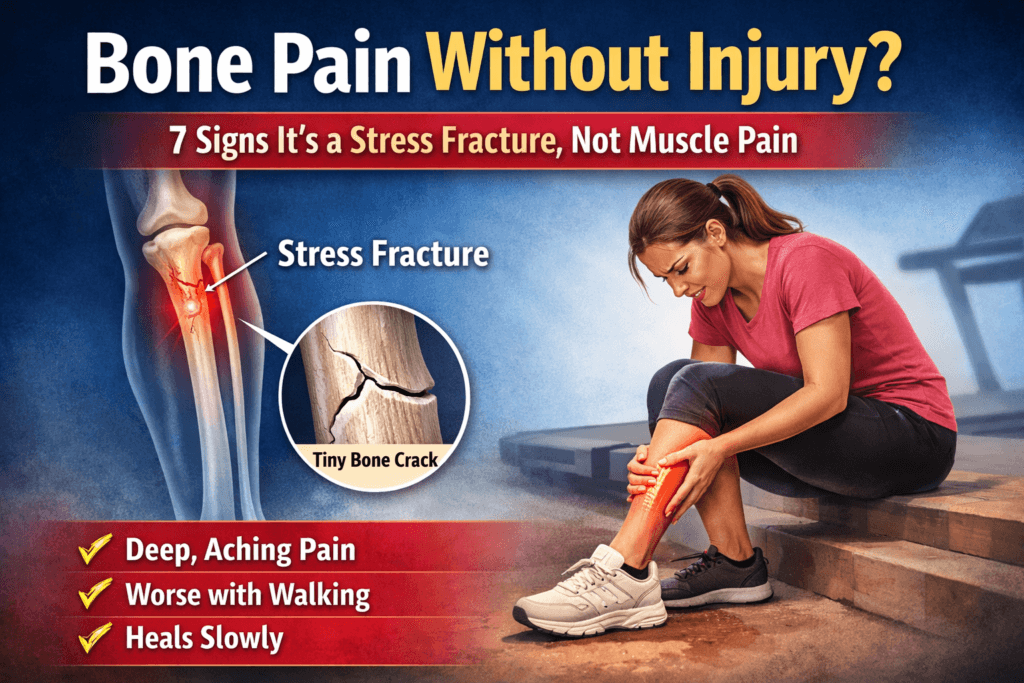
Bone Pain Without Injury: 7 Signs It’s a Stress Fracture and Not Muscle Pain
Bone pain that shows up without a fall, accident, or obvious injury can feel unsettling. One day you’re moving normally, and the next there’s a deep, nagging ache that doesn’t quite make sense, most people immediately rule out a fracture because, in their mind, fractures only happen after something dramatic, a hard fall, a collision, or a visible injury.
That belief is understandable, it’s also wrong, stress fractures are real fractures, not exaggerated pain, not inflammation, and not something you imagined. They don’t announce themselves with a single moment of injury. Instead, they develop quietly, over days or weeks, as repeated stress slowly overwhelms the bone’s natural repair process. No crash, no fall, just load after load after load.
This is why stress fractures are so often misunderstood, the pain starts subtly, it might only appear during activity at first, then fade with rest because nothing happened, many people assume it’s a muscle issue, a minor strain, or something that will resolve on its own. Unfortunately, continuing to push through that pain is exactly what allows a small bone crack to worsen.
Understanding stress fractures matters because they are commonly missed and frequently misdiagnosed, often labeled as muscle strain, tendonitis, or overuse pain. When that happens, people keep training, keep walking, keep working and the bone continues to fail. What could have healed with simple load reduction can progress into a complete fracture that requires months of recovery or even surgery.
This article breaks it down clearly and honestly, what stress fractures actually are, why they can develop without trauma, how the pain typically feels, who is most at risk, how they’re properly diagnosed, and what truly helps them heal. No fear-mongering, no oversimplification, just a clear explanation of why bone pain without injury should never be ignored.
What Is a Stress Fracture?
A stress fracture is a small crack or microscopic break in a bone that develops from repeated mechanical stress rather than a single, forceful injury. There is no dramatic moment when it happens, no fall, no collision, no instant pain that makes you stop in your tracks. Instead, the damage builds quietly over time.
A simple way to understand this is to think about a paperclip. Bend it once, and nothing happens, bend it again and again, and eventually it snaps. The force applied each time isn’t extreme but the repetition is.
Bones behave in a very similar way, bone is not a hard, lifeless structure, it is living tissue that is constantly renewing itself. Every day:
- Old bone is broken down
- New bone is formed in response to stress
This process allows bones to become stronger when they are loaded appropriately but it only works when breakdown and rebuilding stay in balance.
A stress fracture develops when that balance is lost:
- Bone breakdown begins to happen faster than bone repair
- Repetitive stress continues without enough recovery time
- Tiny areas of damage accumulate inside the bone
Eventually, those microscopic injuries merge into a crack that the bone can no longer compensate for, that’s why a stress fracture can exist without any single injury you can point to.
Why Stress Fractures Happen Without Trauma
1. Bone Responds to Repetition, Not Just Force
Bones are designed to handle load but they are not indestructible, activities like running, walking, jumping, marching, standing for long hours, or carrying weight may not seem extreme, but they place repetitive stress on the same areas of bone over and over again. Each step, each landing, each shift of weight creates a small force that the bone must absorb.
When recovery time is adequate, bone adapts and becomes stronger, when it isn’t, fatigue sets in.
Over time:
- Microscopic cracks begin to form inside the bone
- The bone’s structural integrity slowly weakens
- Pain appears before any clear fracture is visible on imaging
This is why someone can honestly say, i didn’t injure myself, i just woke up with bone pain. They’re not minimizing their symptoms, they’re describing how stress fractures actually develop.
2. Increased Activity Without Adequate Adaptation
One of the most common triggers for stress fractures is sudden change, not necessarily extreme effort.
Examples include:
- Starting a new running or exercise program
- Rapidly increasing workout duration or intensity
- Switching from treadmill running to road or trail running
- Walking long distances on hard surfaces
- Military or law-enforcement training
- A new job that requires prolonged standing or walking
Bone adapts slowly, muscles, on the other hand, adapt much faster, when muscles fatigue before bone has time to strengthen, they absorb less shock. That extra load is then transferred directly to the bone, over time the bone pays the price.
This is why people often develop stress fractures shortly after doing something healthy or starting a new routine especially when progression happens faster than the body can handle.
3. Weak Bone Structure (Even If You’re Young)
Stress fractures are often associated with older adults, but age alone is not the determining factor. Young, active, otherwise healthy people get stress fractures every day.
Bone strength depends on more than just age:
- Bone mineral density
- Hormonal balance
- Nutrition and energy availability
- Blood supply
- Mechanical alignment and movement patterns
Someone can have normal-looking X-rays, no diagnosed bone disease, and still develop a stress fracture if bone quality is compromised. Low energy intake, vitamin deficiencies, hormonal disruptions, or subtle biomechanical issues can weaken bone enough that routine activity becomes damaging.
This is why stress fractures should never be dismissed, simply because a person is too young or too active to have bone problems. Bone failure is about load versus capacity, not age or fitness level.
Common Locations of Stress Fractures
Stress fractures don’t occur at random. They tend to appear in load-bearing bones, areas that repeatedly absorb impact, weight, and force during everyday movement. Wherever stress is concentrated and recovery is insufficient, bone fatigue can develop.
The most commonly affected sites include:
- Tibia (shinbone): the single most common location, especially in runners and people who walk or stand for long periods
- Metatarsals (foot bones): often called march fractures, common in military training and long-distance walking
- Femur (thigh bone): less common but more serious due to high load and risk of complications
- Calcaneus (heel bone): absorbs repeated impact with every step
- Pelvis: especially in endurance athletes and postpartum individuals
- Navicular bone (midfoot): a high-risk area because of poor blood supply
- Sacrum (junction of spine and pelvis): often overlooked, especially in people with lower back or hip pain
Stress fractures of the upper body can occur, particularly in sports involving repetitive arm loading, but they are far less common than those in the lower extremities.
What Stress Fracture Pain Feels Like
Stress fracture pain follows a predictable progression, and recognizing this pattern is one of the most important steps toward early diagnosis.
Early-Stage Pain
At first, the pain is subtle and easy to dismiss:
- A dull, localized ache
- Appears only during activity
- Improves or disappears with rest
- Feels deep, as if it’s coming from inside the limb rather than the surface
At this stage, many people continue normal activity because the pain seems manageable or not serious enough.
Progressive Pain
As bone damage accumulates, the pattern changes:
- Pain starts earlier during activity
- The ache becomes sharper and more noticeable
- Pain may linger after stopping activity
- The painful spot becomes easier to pinpoint with one finger
This is often the turning point, when the body is clearly signaling that something is wrong.
Advanced Pain
If the stress continues unchecked, symptoms escalate:
- Pain occurs even at rest
- Night pain may develop
- Pain with walking or standing becomes constant
- Local swelling or tenderness over the bone appears
- Limping or altered movement patterns develop
This progression matters, what starts as a small, manageable injury can evolve into a serious fracture if early warning signs are ignored.
Why Stress Fractures Are Often Misdiagnosed
Stress fractures are among the most frequently missed musculoskeletal injuries, especially in their early stages. They are commonly mistaken for:
- Muscle strain
- Shin splints
- Tendonitis
- Plantar fasciitis
- Arthritis
- Nerve-related pain
There are several reasons for this.
1. Early X-Rays Are Often Normal
Up to 70% of early stress fractures do not appear on plain X-ray. Structural changes in bone lag behind symptoms, so imaging can look normal even when significant bone stress is present. This can create false reassurance, for both patients and clinicians.
2. The Pain Sounds Too Mild to Be a Fracture
Most people associate fractures with sudden, severe pain and immediate loss of function. Stress fractures don’t behave that way, they are quiet, gradual, and deceptive, which leads many people to underestimate their seriousness.
3. Overuse Pain Is Often Normalized
Athletes and physically active individuals are frequently told:
“Pain is part of training.”
While some discomfort is normal, bone pain is different. Treating stress fracture pain as something to push through is one of the fastest ways to turn a small injury into a major one.
Risk Factors You Should Take Seriously
You don’t need every risk factor to develop a stress fracture. For many people, one or two are enough.
Mechanical Factors
- Sudden increase in activity or training load
- Poor or worn-out footwear
- Hard or unforgiving training surfaces
- Abnormal gait or movement mechanics
- Leg length discrepancy
Biological Factors
- Low bone mineral density
- Vitamin D deficiency
- Inadequate calcium intake
- Hormonal imbalance
- Menstrual irregularities
- Low testosterone levels
- Thyroid disorders
Medical Conditions
- Osteoporosis or osteopenia
- Eating disorders or low energy availability
- Malabsorption syndromes
- Long-term steroid use
- Rheumatoid arthritis
Lifestyle Factors
- Chronic psychological stress
- Poor sleep quality
- Inadequate recovery time
- Overtraining without rest
Stress fractures are not always about doing too much. Very often, they are about recovering too little, physically, hormonally, and nutritionally. When recovery fails, bone eventually reaches its breaking point.
Stress Fractures vs Other Causes of Bone Pain
Not all pain that feels deep or intense is coming from bone. One reason stress fractures are frequently missed is because their symptoms overlap with muscle, joint, and nerve problems. Understanding the differences helps prevent dangerous delays in diagnosis.
Stress Fracture vs Muscle Pain
Stress fracture pain and muscle pain behave very differently once you pay attention to the pattern.
Stress fracture pain:
- Feels sharp, focused, and easy to localize
- Often worsens with impact activities like walking, running, or jumping
- Improves with rest only in the early stages
- Is tender directly over the bone when pressed
Muscle pain:
- Feels more diffuse or spread out
- May ache or tighten with use
- Typically improves significantly with rest, stretching, or massage
- Is not sharply tender over a specific point of bone
If pressing on one exact spot reproduces the pain, bone not muscle should be suspected.
Stress Fracture vs Joint Pain
Joint pain usually has a different signature:
- Stiffness, especially after rest
- Swelling around the joint
- Reduced range of motion
- Pain that worsens with joint movement rather than impact
Stress fracture pain, in contrast, is mechanical and focal. It often feels worse with weight-bearing or impact but does not limit joint motion in the same way. The joint itself may move normally while pain persists underneath.
Stress Fracture vs Nerve Pain
Nerve-related pain has its own distinct characteristics:
- Burning, tingling, or electric sensations
- Shooting pain that travels along a nerve path
- Numbness or weakness in some cases
Stress fracture pain does not tingle or radiate. It typically aches deeply or stabs with load, becoming worse when force is transmitted through the bone.
How Stress Fractures Are Diagnosed
Diagnosing a stress fracture early requires attention to history and symptom pattern, not just imaging results.
1. Clinical Suspicion Comes First
In the early stages, history matters more than tests.
Red flags that raise concern include:
- Bone pain that appears or worsens with activity
- Localized tenderness in one specific spot
- Symptoms that progressively worsen over time
- Pain without any clear traumatic injury
When these features are present, stress fracture should remain high on the list, even if initial tests look normal.
2. Imaging: What Works and What Doesn’t
X-ray
- Often normal in the early stages
- May only show a fracture line or callus weeks later
- Useful, but not reliable early on
MRI (Gold Standard)
- Detects early bone stress reactions
- Shows bone marrow edema before a crack fully forms
- Helps identify high-risk versus low-risk fractures
Bone Scan
- Highly sensitive but less specific
- Can show increased bone activity
- Used mainly when MRI is unavailable
If a stress fracture is suspected and the X-ray is normal, MRI is not optional, it’s essential. Relying on a normal X-ray alone is a common reason these injuries are missed.
High-Risk vs Low-Risk Stress Fractures
Not all stress fractures heal the same way. Location matters.
Low-Risk Stress Fractures
These typically heal well with conservative management:
- Good blood supply
- Lower risk of complications
- Rarely require surgery
Common examples:
- Posteromedial tibia
- Metatarsal shafts
- Calcaneus
With proper load reduction, these fractures usually heal predictably.
High-Risk Stress Fractures
These require closer monitoring and more aggressive management:
- Poor blood supply
- Higher risk of delayed healing or non-union
- Greater chance of progression to complete fracture
Common examples:
- Femoral neck
- Navicular bone
- Anterior tibia
- Base of the fifth metatarsal
These are not injuries to push through. Delayed or improper treatment can have long-term consequences.
Treatment: What Actually Works
Treating stress fractures isn’t about shortcuts. It’s about respecting bone biology.
1. Load Reduction
Bone heals when excessive stress is removed but that doesn’t always mean complete immobilization.
Depending on severity and location, options include:
- Modifying or stopping high-impact activities
- Temporary off-loading of the affected limb
- Use of crutches or a walking boot
- Low-impact cross-training if approved
The goal is bone recovery, not unnecessary muscle loss or deconditioning.
2. Nutrition Is Not Optional
Bone repair is metabolically demanding. Healing requires:
- Adequate overall calorie intake
- Sufficient protein
- Calcium
- Vitamin D
Deficiencies can dramatically slow healing or prevent it altogether. Supplementation is useful only when a deficiency exists, taking supplements blindly does not replace proper assessment or treatment.
3. Gradual Return to Activity
Returning to activity too quickly is the most common cause of re-injury.
A safe return involves:
- Being pain-free during normal daily activities
- Gradual, stepwise increase in load
- Close monitoring of symptoms
- Addressing biomechanical or training errors
Pain is not weakness. It is feedback and ignoring it invites repeat injury.
4. Surgery
Surgery is reserved for specific situations, including:
- High-risk fracture locations
- Displaced fractures
- Fractures that fail to heal with conservative treatment
For most people, surgery is avoidable. But when it’s needed, delaying it only worsens outcomes. Surgery is the exception, not the rule but pretending it’s never necessary is just as dangerous.
Why Ignoring Bone Pain Is a Mistake
Bone pain is not the same as muscle soreness, and treating it as such is a serious error. Muscles can tolerate short-term overload and recover quickly. Bone cannot. When bone pain is ignored, the damage doesn’t stay the same, it progresses.
Pushing through stress fracture pain can lead to:
- A complete fracture instead of a small crack
- Bone displacement, where broken ends move out of alignment
- Surgical intervention that could have been avoided
- Months of reduced mobility or non-weight-bearing
- Long-term changes in movement patterns and biomechanics
What makes this especially dangerous is that stress fracture pain often feels manageable at first. That false sense of control encourages continued activity, which accelerates bone failure. Early recognition allows for simple, effective treatment, delayed diagnosis turns a short recovery into a long one.
Can Stress Fractures Be Prevented?
Not entirely but the risk can be significantly reduced.
Bone responds to stress by becoming stronger, but only when stress is applied gradually and followed by adequate recovery. Problems arise when load increases faster than the bone can adapt.
Key prevention strategies include:
- Gradual progression of training intensity and volume
- Allowing sufficient recovery time between high-impact activities
- Wearing appropriate, well-fitted footwear for the activity and surface
- Strength training to improve shock absorption and movement control
- Identifying and correcting nutritional deficiencies
- Paying attention to early pain signals instead of dismissing them
Prevention isn’t about avoiding stress. It’s about respecting the time bone needs to respond to it.
When to Seek Medical Evaluation
Waiting it out is rarely the right move when bone pain is involved.
Seek medical evaluation if you experience:
- Localized bone pain lasting longer than one to two weeks
- Pain that worsens with activity or impact
- Pain that improves with rest but consistently returns
- Pain that occurs at night or at rest
- Limping or changes in the way you walk
- Swelling or tenderness directly over a bone
Early evaluation and appropriate imaging can prevent complications, shorten recovery time, and reduce the risk of long-term consequences. When it comes to bone pain, time is not neutral acting early makes a measurable difference.
The Bottom Line
Stress fractures are not rare accidents, signs of weakness, or pain you can think your way out of. They are a predictable biological response to how bone actually works.
Bone is living tissue, it constantly breaks down and rebuilds itself. When stress is applied faster than recovery allows, damage accumulates, that’s the reality.
Repetition matters, recovery matters. Ignoring pain does not make bone stronger, it makes it fail.
Bone pain without trauma is never random, it is information sometimes it’s an early warning, sometimes it’s a fracture already forming. The difference between a short recovery and a long, life-disrupting injury often comes down to whether that signal is respected early or dismissed.
Pushing through bone pain doesn’t make you disciplined or resilient, it just delays healing and increases damage. Listening to your body isn’t weakness, it’s how you stay active, mobile, and functional for the long term.
👩⚕️ Need Personalized Health Advice?
Get expert guidance tailored to your unique health concerns through MuseCare Consult. Our licensed doctors are here to help you understand your symptoms, medications, and lab results—confidentially and affordably.
👉 Book a MuseCare Consult NowRecommended Post:
- Essential Guide to Lower Back, Joint, and Bone Pain: Causes, Diagnosis, and Effective Treatments
- MRI vs X-Ray vs CT Scan for Pain Diagnosis: 5 ways to Choose the Right Imaging
- Osteoarthritis vs Rheumatoid Arthritis: 7 Key Pain Patterns You Must Know
- 10 Critical Causes of Joint Pain With Swelling but No Injury (What Doctors Look For)
- Bone Pain vs Muscle Pain vs Joint Pain:7 Ways to Tell the Difference & What It Means
- 13 Proven Causes of Joint Pain Without Injury (Medical Guide That Explains the Real Reasons)

Dr. Ijasusi Bamidele, MBBS (Binzhou Medical University, China), is a medical doctor with 5 years of clinical experience and founder of MyMedicalMuse.com, a subsidiary of Delimann Limited. As a health content writer for audiences in the USA, Canada, and Europe, Dr. Ijasusi helps readers understand complex health conditions, recognize why they have certain symptoms, and apply practical lifestyle modifications to improve well-being