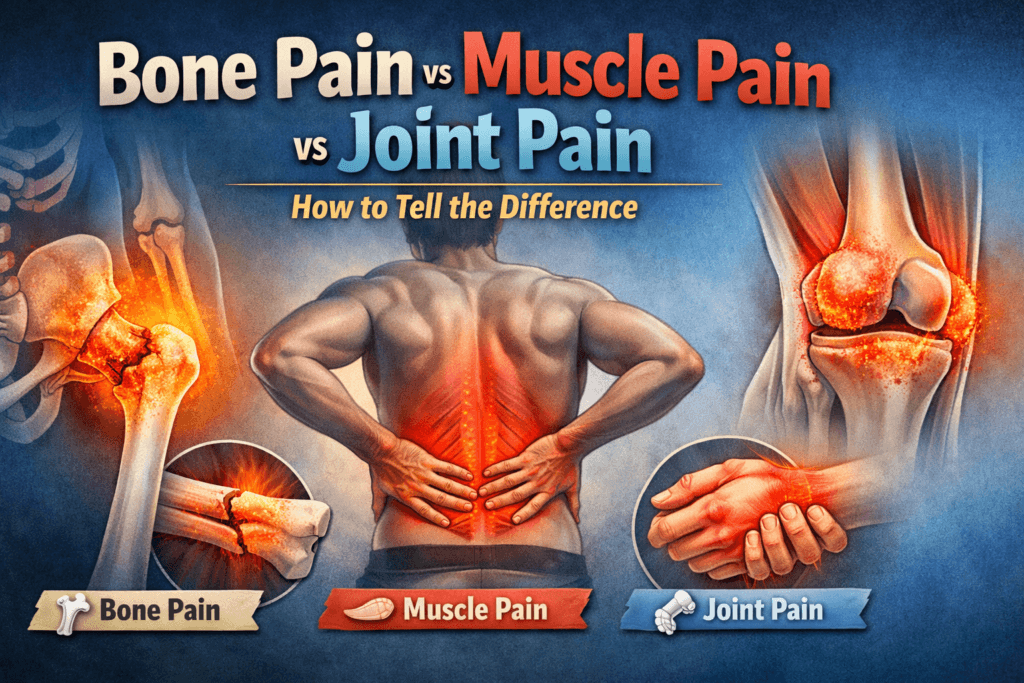
Bone Pain vs Muscle Pain vs Joint Pain: How to Tell the Difference & What It Means
Pain is not random, it is not meaningless noise, it is the body sending information from a specific tissue for a specific reason. The problem is not pain itself, the problem is misinterpretation.
Most people misunderstand where their pain is actually coming from, they describe deep muscle tension as bone pain, they assume joint stiffness is arthritis. They dismiss persistent bone pain as simple soreness. These errors are common and they matter.
When pain is mislabeled, the response is wrong. wrong treatment delays recovery,
wrong assumptions create fear or false reassurance and in some cases, serious conditions are missed entirely.
Treating muscle pain like joint disease wastes time, treating joint inflammation like muscle strain prolongs damage. Ignoring true bone pain can carry real risk.
This article breaks the confusion down clearly, you’ll learn how bone pain, muscle pain, and joint pain differ based on how they feel, how they behave with movement and rest, what typically causes them, and when they should not be ignored.
Why Identifying the Source of Pain Matters
Pain by itself does not explain what is wrong, its behavior does.
Different tissues respond differently to movement, rest, pressure, and time. Once you understand those patterns, the differences are not subtle, they are obvious. When pain is misidentified, the response is almost always wrong, using painkillers may reduce discomfort while the underlying problem continues. Doing the wrong exercises can irritate the tissue further instead of helping it heal.
Inflammatory or systemic disease may go unrecognized, serious bone conditions may be diagnosed late and what should have been temporary pain can become chronic simply because the wrong approach was taken.
Pain is not the enemy, it is information. Correct interpretation changes outcomes, incorrect interpretation delays them.
What Bone Pain Really Is
True bone pain is uncommon, and that is exactly why it deserves attention. Bones are not highly sensitive structures. They do not generate pain easily, when a bone hurts, it usually means something meaningful is happening inside the bone itself, not in the surrounding muscles or joints. This is why true bone pain is different in quality, behavior, and significance.
How Bone Pain Feels
Bone pain is deep and internal. People often struggle to point to it clearly or reproduce it with touch. It feels as though it comes from within the limb rather than from the surface.
Common descriptions include a deep aching or pressure, a dull throbbing that does not change with position, or a heavy internal pain that feels distinctly different from muscle soreness. Bone pain often persists at rest and may be severe enough to wake someone from sleep. Unlike muscle or joint pain, it does not improve with stretching, massage, or changes in posture.
If movement, pressure, or position barely affects the pain, that is an important clue that the source may be bone.
How Bone Pain Behaves
Bone pain follows a pattern that sets it apart, it tends to be constant rather than activity-dependent.
It often persists during rest, it may worsen at night, it frequently progresses gradually over time and it usually feels the same regardless of movement.
This predictable behavior is what clearly separates bone pain from muscle and joint pain.
Causes of Bone Pain
Not all causes of bone pain are dangerous, but some are serious enough that delay matters. Less serious causes can include healing fractures, stress fractures, bone bruises, vitamin D deficiency, or rapid growth in children and adolescents.
More serious causes include bone infections, primary bone tumors, metastatic cancer spreading to bone, blood-related cancers, and severe osteoporosis causing microfractures.
Bone pain without a clear injury should never be dismissed, especially if it is persistent or worsening over time.
Bone Pain Warning Signs
Bone pain requires medical evaluation if it occurs without injury, is localized to one specific spot, or is present at night.
It should also be taken seriously if it does not improve with rest, is associated with fever, unexplained weight loss, or persistent fatigue, or is accompanied by swelling, redness, or warmth over the area.
True bone pain is rare, but when it exists, it carries the highest risk if overlooked.
What Muscle Pain Actually Is
Muscle pain is the most common type of pain people experience, and in most cases, it is the least dangerous. It is mechanical in nature, that means it responds to use, load, and rest in predictable ways. Muscle tissue is designed to adapt, and pain often reflects temporary overload rather than injury. When understood correctly, muscle pain is usually reassuring rather than alarming.
How Muscle Pain Feels
Muscle pain typically feels achy or sore, often accompanied by a sense of tightness or cramping. The area is usually tender to touch, and the pain becomes more noticeable when the muscle is used.
A key feature of muscle pain is that it improves with rest. It may feel uncomfortable during activity but settles when the muscle is no longer being loaded. Muscle pain is also easy to reproduce, pressing on the muscle, stretching it, or contracting it against resistance usually brings the pain on or makes it worse. If this happens, the source is almost always muscle tissue.
How Muscle Pain Behaves
Muscle pain is dynamic, it changes with movement, posture, and activity level.
It typically increases with effort and decreases with rest. Light movement, gentle stretching, or heat often reduce discomfort rather than aggravate it.
Another defining feature is time, muscle pain fades whether it comes from overuse, strain, or delayed-onset muscle soreness after exercise, it usually improves over days to weeks as the tissue adapts and recovers.
This variability, pain that changes with use and improves with time is the strongest clue that the pain is muscular.
Common Causes of Muscle Pain
Muscle pain most often results from mechanical stress rather than structural damage.
Common causes include repetitive activity, sudden increases in exercise intensity or volume, poor posture, prolonged sitting, minor muscle strains, dehydration, electrolyte imbalance, and delayed-onset muscle soreness following unaccustomed activity.
In the vast majority of cases, muscle pain represents adaptation, not injury.
When Muscle Pain Is Not Normal
Although muscle pain is usually harmless, there are situations where it needs medical evaluation. Muscle pain should be assessed if it appears suddenly without physical activity, is severe or disabling, is accompanied by true muscle weakness rather than discomfort, is associated with dark urine or extreme fatigue, or persists for weeks without any improvement.
These scenarios are uncommon, but they matter because they point to systemic or metabolic problems rather than simple mechanical strain.
What Joint Pain Really Means
Joint pain comes from the structures that allow bones to move against each other. These include cartilage, the joint capsule, ligaments, and synovial tissue.
This is where many chronic musculoskeletal conditions originate, particularly those involving degeneration or inflammation. Joint pain often behaves differently from muscle pain, and those differences are clinically important.
How Joint Pain Feels
Joint pain is usually localized to a specific joint, such as the knee, hip, shoulder, or fingers. The pain worsens when the joint moves through its range of motion rather than when a specific muscle contracts. Stiffness is a common feature, especially after periods of inactivity. Swelling may or may not be present, and some people notice clicking, grinding, or a sensation of catching within the joint.
Joint pain often feels worse after rest and may improve once the joint warms up with gentle movement.
Types of Joint Pain
Joint pain generally falls into two broad categories: mechanical and inflammatory, distinguishing between them is essential.
Mechanical joint pain worsens with use and improves with rest, swelling is usually minimal, stiffness after rest is brief, and symptoms are often related to aging, joint wear, or repetitive stress.
Inflammatory joint pain behaves differently, it causes prolonged morning stiffness, often lasting more than an hour. Movement tends to improve symptoms rather than worsen them. Swelling and warmth are more common, multiple joints may be involved, and fatigue is often present.
This distinction matters because inflammatory joint pain requires targeted medical treatment. Pain relief alone is not enough.
Conditions Commonly Causing Joint Pain
Joint pain can arise from mechanical wear, inflammation, or immune dysfunction. Identifying which category a condition falls into is critical because treatment strategies differ completely.
Mechanical causes of joint pain include osteoarthritis, cartilage degeneration, joint instability, and overuse injuries. In these cases, pain is driven by load, repetition, and structural stress. Symptoms typically worsen with activity and improve with rest.
Inflammatory causes of joint pain include rheumatoid arthritis, psoriatic arthritis, lupus, gout, and reactive arthritis. These conditions involve immune system activity within the joint. Pain is often accompanied by swelling, warmth, prolonged stiffness, and fatigue.
Joint pain is frequently the earliest sign of autoimmune disease, when multiple joints are affected or stiffness lasts a long time in the morning, inflammation should be considered even if imaging appears mild.
Practical Ways to Tell the Difference at Home
You do not need medical equipment to gather meaningful clues about where pain is coming from. Careful observation of how pain behaves can be surprisingly accurate. If pain increases when you contract a muscle or stretch it, the source is likely muscular.
If pain increases when a joint moves through its full range of motion, the source is more likely the joint itself. If pain does not change with movement, pressure, or position, bone or nerve-related pain becomes more likely and should not be ignored.
If pressing on the area reproduces the pain, muscle or joint tissue is involved. If the pain is deep and cannot be reproduced with touch, bone pain should be considered. If pain improves with rest, muscle pain is likely, if pain worsens after rest and improves with movement, inflammatory joint pain becomes more likely, if pain is constant during the day and night, bone pain should not be dismissed. Patterns matter more than intensity.
Why Painkillers Can Be Misleading
Painkillers reduce symptoms, they do not explain or correct the underlying cause. They can mask bone disease, delay diagnosis, provide false reassurance, and allow ongoing damage to continue unnoticed.
Temporary relief does not mean the problem is resolved, if pain returns unchanged when medication wears off, the underlying issue is still present. Painkillers are tools, they are not answers.
Why People Say Bone Pain When It Isn’t
Most people have limited anatomical awareness, deep pain feels internal, so it is often labeled as bone pain even when the source is muscle, tendon, or joint tissue.
In reality, the majority of what people describe as bone pain comes from muscle trigger points, tendon overload, joint capsule inflammation, or referred pain from the spine. True bone pain is uncommon, that rarity is exactly why it should be taken seriously when suspected.
Imaging and Testing: When It Makes Sense
Imaging should be guided by symptoms, not fear or curiosity.
X-rays are useful for identifying fractures, arthritis, and obvious bone disease, but they do not show muscles or early inflammatory changes well. MRI is valuable for evaluating soft tissue injuries, bone marrow abnormalities, and complex joint problems when clinically indicated.
Blood tests are important when inflammatory or systemic disease is suspected, particularly when pain is accompanied by stiffness, swelling, fatigue, or multiple joint involvement. Testing without a clear clinical question often creates confusion rather than clarity.
When to Seek Medical Attention Immediately
Medical evaluation should not be delayed if pain is severe and unexplained, progressively worsening, or predominantly present at night.
Urgent assessment is also warranted if pain is associated with fever, persistent fatigue, unexplained weight loss, localized bone pain without injury, or neurological symptoms such as weakness, numbness, or loss of function. Ignoring these signs does not make you resilient.
It makes you vulnerable.
Chronic Pain and Tissue Capacity
Chronic pain is rarely explained by tissue damage alone. In many cases, the original injury has healed, but the tissue has not fully regained its capacity to tolerate load, movement, or stress. Over time, this mismatch between what the tissue can handle and what daily life demands becomes the real driver of pain.
Chronic pain often reflects reduced tissue capacity, poor tolerance to normal loading, incomplete or inconsistent rehabilitation, and protective movement patterns that limit recovery rather than support it. In some cases, the nervous system itself becomes sensitized, amplifying pain signals even in the absence of ongoing damage.
This does not mean the pain is imagined, it means the problem is more complex than structural injury alone.
When pain persists, the solution usually requires rebuilding strength, restoring confidence in movement, and gradually increasing what the tissue can tolerate not simply suppressing symptoms with medication.
What Actually Helps Based on Pain Type
Effective treatment depends on matching the strategy to the tissue involved. Muscle pain improves with gradual loading, adequate rest, proper hydration, and consistent movement. Avoiding activity completely often prolongs recovery rather than accelerating it.
Joint pain responds best to improving strength and stability around the joint, managing load intelligently, addressing contributing factors such as body weight when relevant, and controlling inflammation when it is present. Movement is usually part of the solution, not the problem.
Bone pain requires clarity before action because true bone pain can signal serious underlying conditions, diagnosis must come first. Treating suspected bone pain blindly with exercise or medication is a mistake.
Different tissues fail in different ways, they also recover in different ways. Matching treatment to tissue type is what turns pain management into actual recovery.
The Bottom Line
Bone pain, muscle pain, and joint pain are not interchangeable, even though they are often spoken about as if they are. Muscle pain is common, mechanical, and usually reflects temporary overload or adaptation. It responds to movement, rest, and time, and in most cases, it is not dangerous.
Joint pain is different, it often signals structural wear, inflammation, or immune-related dysfunction. When ignored or mismanaged, it can quietly progress and limit function long before damage becomes obvious.
Bone pain is rare, that rarity is precisely why it matters, when bone pain is real, it should never be brushed aside or treated casually, it demands clarity, evaluation, and respect.
Pain itself is not the enemy.
It is a message, the real problem begins when that message is misunderstood, dismissed, or silenced without being interpreted. Learning to distinguish where pain comes from is not about fear, it is about accuracy and accuracy is what turns pain from a threat into useful information.
👩⚕️ Need Personalized Health Advice?
Get expert guidance tailored to your unique health concerns through MuseCare Consult. Our licensed doctors are here to help you understand your symptoms, medications, and lab results—confidentially and affordably.
👉 Book a MuseCare Consult NowRelated Blog Post:
- Essential Guide to Lower Back, Joint, and Bone Pain: Causes, Diagnosis, and Effective Treatments
- 15 Proven Natural Ways to Improve Joint Stiffness Without Medication
- 13 Proven Causes of Joint Pain Without Injury (Medical Guide That Explains the Real Reasons)
- 7 Surprising Causes of Joints Cracking Loudly and How to Stop It
- 7 Alarming Signs of Vitamin D Deficiency Fatigue and Joint Pain
- 10 Proven Ways to Reduce Morning Lower Back Pain: Real Solutions That Work

Dr. Ijasusi Bamidele, MBBS (Binzhou Medical University, China), is a medical doctor with 5 years of clinical experience and founder of MyMedicalMuse.com, a subsidiary of Delimann Limited. As a health content writer for audiences in the USA, Canada, and Europe, Dr. Ijasusi helps readers understand complex health conditions, recognize why they have certain symptoms, and apply practical lifestyle modifications to improve well-being