
⚠️ Affiliate Disclaimer: This post may contain affiliate links, which means I may earn a small commission at no extra cost to you, if you make a purchase through one of these links. I only recommend products or services I genuinely trust and believe can provide value. Thank you for supporting My Medical Muse!
Why Normal Blood Sugar Readings Can Still Hide Diabetes: 10 Shocking Truths You Must Know
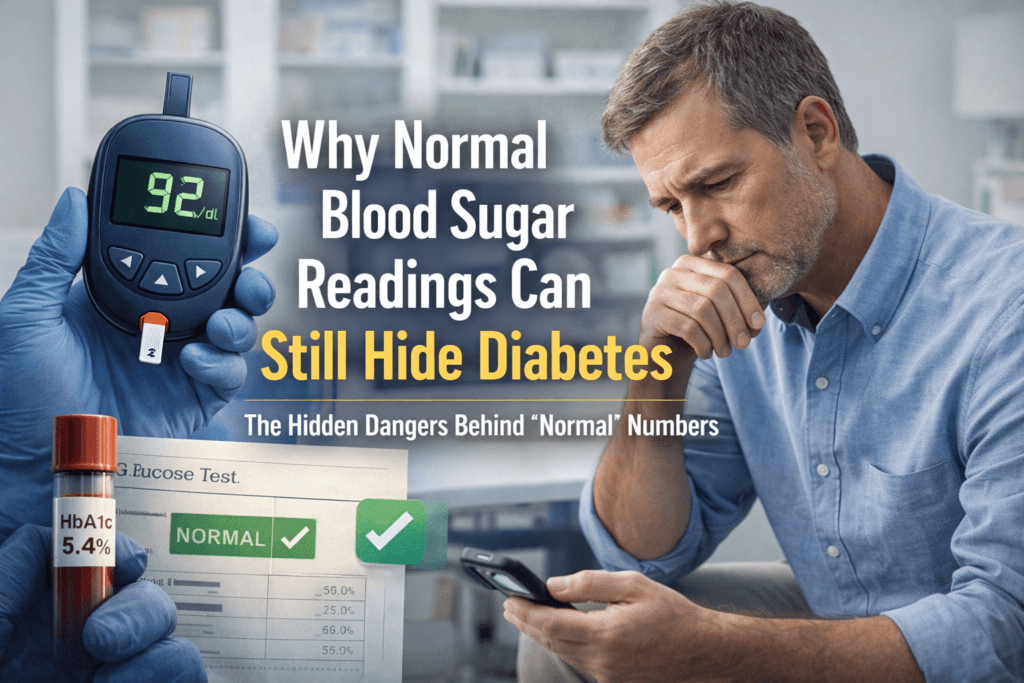
Your blood sugar is normal. For many people, those words end the conversation. A fasting glucose of 92 mg/dL, HbA1c of 5.4%. A random finger-stick that looks acceptable, relief sets in, vigilance fades, life moves on.
That comfort is often misplaced, normal blood sugar values do not automatically mean healthy glucose regulation, in reality, some of the most biologically active and most damaging stages of diabetes unfold before standard tests ever cross diagnostic cutoffs. What looks normal on paper may be the result of aggressive internal compensation, not true metabolic health.
Diabetes does not appear suddenly when a number turns red, it develops silently, as regulatory systems strain, adapt, and eventually fail. For years, the body can mask this dysfunction by producing more insulin, shifting fuel storage, and suppressing visible glucose elevations, long enough for routine labs to appear reassuring.
This is why relying solely on normal readings can be misleading.
This article breaks down how diabetes can exist beneath normal blood sugar results, why conventional testing frequently misses early disease, and which signals actually expose the problem before irreversible damage sets in.
Diabetes Is a Process, Not a Number
The most persistent misconception about diabetes is the belief that it begins the moment blood glucose crosses a diagnostic line, it doesn’t.
Diabetes starts much earlier, when the body begins to lose efficiency in glucose regulation, not when glucose finally rises high enough to trigger a label. The elevated number is not the disease, it is the late visible outcome of a process that has been unfolding quietly for years.
Human metabolism is remarkably adaptive, when regulation starts to fail, the body does not immediately allow glucose to rise instead, it compensates, forcefully and repeatedly, using powerful hormonal mechanisms to keep blood sugar within a narrow, seemingly healthy range. That compensation can persist for a long time.
By the point fasting glucose or HbA1c becomes abnormal, the metabolic system may already be under significant strain, insulin pathways are stressed, fat storage patterns have shifted, inflammation is rising, and organ-level damage may already be underway. The abnormal number is not the beginning, it is the warning that compensation is finally breaking down.
The Body’s First Line of Deception: Insulin Compensation
To understand how normal readings can mask disease, insulin must be understood for what it truly is not merely a sugar-lowering hormone, but a master regulator of energy metabolism.
Insulin Is a Regulatory Hormone
Insulin’s effects extend far beyond moving glucose out of the bloodstream, it plays a central role in deciding how the body stores, uses, and prioritizes energy, Insulin:
- Drives glucose into muscle and fat cells
- Suppresses glucose release from the liver
- Signals a state of energy abundance
- Promotes fat storage
- Inhibits fat breakdown
Under healthy conditions, this system is tightly controlled, insulin rises after meals, directs glucose into cells, and then falls back to baseline.
Problems begin when tissues particularly muscle, liver, and fat become less responsive to insulin’s signal, when insulin resistance develops, the pancreas does not immediately fail, instead it responds by producing more insulin to achieve the same glucose-lowering effect. Blood sugar stays normal, but only because insulin levels are chronically elevated, this state is known as hyperinsulinemia, high insulin in the presence of normal glucose, on the surface, everything looks fine underneath, the system is under constant pressure.
Standard glucose tests measure the result of this compensation, not the cost, they show the number, not the effort required to maintain it.
Stage 1: Insulin Resistance With Normal Glucose
This is the earliest phase of diabetes and the most frequently missed, at this stage, the disease is active, but hidden.
What’s happening internally
- Muscle cells respond poorly to insulin, requiring higher levels to absorb glucose
- The liver continues releasing glucose despite insulin’s signal to stop
- Fat tissue becomes metabolically dysfunctional, releasing inflammatory signals
- The pancreas increases insulin output to compensate for resistance
Every system involved in glucose regulation is already strained, yet glucose itself remains controlled.
What standard tests show
- Fasting glucose: normal
- HbA1c: normal
- Random glucose: normal
These results often lead to reassurance, not investigation.
What’s actually wrong:
- Insulin levels are chronically elevated
- Metabolic stress is already present
- Fat accumulation especially visceral fat increases
- Low-grade inflammation rises
- Cardiovascular risk begins climbing
This is not health, it is compensation. The body is maintaining normal numbers at the expense of long-term stability.
Why Fasting Blood Sugar Misses Early Diabetes
Fasting glucose is one of the most commonly used screening tools and one of the most limited, it measures a single thing, how well the body maintains glucose after several hours without food. What it does not measure is often far more important.
Fasting glucose does not reflect:
- Post-meal glucose spikes
- Insulin output or insulin burden
- Tissue sensitivity to insulin
- Day-to-day glucose variability
A person can have severe insulin resistance, extremely high insulin levels, and dangerous post-meal glucose excursions and still wake up with a fasting glucose that appears normal.
Why does this happen? Because insulin remains elevated overnight, powerfully suppressing glucose production by the liver. The pancreas is working relentlessly to keep glucose controlled while the person sleeps. The fasting number looks calm, the physiology behind it is anything but.
Fasting glucose shows the outcome, not the effort required to achieve it.
HbA1c: Stable, Convenient, and Incomplete
HbA1c is often described as the gold standard because it reflects the average blood glucose over approximately three months, that sounds comprehensive but it isn’t. Averages are smooth. Biology is not.
What HbA1c fails to capture
- Short but frequent glucose spikes
- Significant post-meal hyperglycemia
- Wide daily glucose swings
- Early insulin resistance masked by compensation
A person may experience sharp glucose spikes to 180-220 mg/dL after meals, followed by rapid drops driven by excessive insulin release. When those highs and lows are averaged together, the final HbA1c may still fall within the normal range.
The instability disappears into the math. HbA1c turns metabolic turbulence into a single comforting number, it answers a convenient question:
“What was the average?”
But it ignores the far more important one:
How hard did the body have to work to keep it there?
That hidden effort, chronic insulin overproduction is where early diabetes truly lives.
Post-Meal Glucose: Where Diabetes Often Reveals Itself First
For many individuals, diabetes does not begin in the fasting state, it begins after meals. Early glucose dysregulation is most visible when the system is challenged, not when it is at rest. Long before fasting glucose rises, subtle failures appear in how the body handles incoming carbohydrates.
Early dysfunction typically shows up as:
- Delayed clearance of glucose from the bloodstream
- Excessively high post-meal glucose peaks
- Prolonged elevation of glucose hours after eating
These abnormalities reflect impaired insulin signaling, delayed insulin release, or both. Yet most routine testing never looks here.
Many people have never measured their blood sugar:
- 30 minutes after eating
- 1 hour post-meal
- 2 hours post-meal
Those time points are where early diabetes often becomes visible. When post-meal glucose remains elevated longer than it should, the body is signaling that regulation is already compromised even if fasting numbers still look reassuring.
The Oral Glucose Tolerance Test: Uncomfortable but Honest
The Oral Glucose Tolerance Test (OGTT) involves ingesting 75 grams of glucose and measuring blood sugar responses over time. It is not convenient, it is not quick, it is not comfortable, it is, however, one of the most revealing metabolic tests available.
Why? Because it stresses the system, early diabetes is rarely a problem of baseline glucose control. It is a problem of performance under load. When challenged with a glucose surge, a compromised system reveals itself.
A normal fasting glucose combined with an abnormal OGTT indicates:
- Inability to manage glucose challenges efficiently
- Delayed or insufficient insulin response
- Early pancreatic beta-cell stress
Many individuals with normal routine labs fail the OGTT. That failure is not benign. It predicts future diabetes years before fasting glucose or HbA1c become abnormal.
The test exposes dysfunction that averages and resting measurements conceal.
Hyperinsulinemia: The Silent Driver of Damage
High insulin levels are often dismissed as irrelevant if glucose appears normal, that dismissal is a mistake. Chronic hyperinsulinemia is not protective, it is pathologic.
Persistently elevated insulin:
- Promotes fat gain, even with modest calorie intake
- Drives visceral and abdominal fat accumulation
- Raises blood pressure through sodium retention and vascular effects
- Alters lipid profiles, increasing triglycerides and lowering HDL
- Increases cardiovascular risk independent of glucose
- Further worsens insulin resistance over time
Despite these effects, insulin is rarely measured in routine care. As a result, many people are told, your sugar is fine. Meanwhile, insulin quietly drives metabolic damage across multiple organ systems.
Normal glucose does not neutralize the harm of chronically elevated insulin.
Normal Numbers, Abnormal Symptoms
Long before laboratory thresholds are crossed, many people feel that something is wrong.
These early symptoms are often dismissed, minimized, or attributed to stress or lifestyle, but they are physiologic signals of dysregulation not imagination.
Common symptoms during normal glucose stages include:
- Fatigue or heaviness after meals
- Brain fog and reduced concentration
- Intense hunger shortly after eating
- Strong sugar or carbohydrate cravings
- Weight gain despite consistent effort
- Disproportionate abdominal fat accumulation
- Difficulty losing weight
- Symptoms of reactive hypoglycemia, such as shakiness or irritability
These experiences reflect unstable glucose-insulin dynamics. The regulatory system is strained, oscillating between spikes and drops, even though average numbers appear acceptable.
The numbers haven’t caught up yet but the physiology already has.
The Liver’s Role in Hiding Diabetes
The liver is central to glucose regulation, and it plays a major role in masking early diabetes. Under healthy conditions, insulin signals the liver to reduce glucose production. In insulin resistance, that signal is ignored.
As a result:
- The liver continues releasing glucose into the bloodstream
- The pancreas increases insulin output to counteract it
- Fasting glucose remains normal, temporarily
This creates a metabolic tug-of-war that can persist for years. Elevated insulin suppresses glucose enough to maintain normal fasting values, but only through relentless compensation.
Eventually, the pancreas can no longer keep up. When insulin output finally falls behind hepatic glucose production, fasting glucose rises.
That moment is often labeled “diabetes.”
In reality, it represents late-stage failure, not disease onset.
Beta-Cell Burnout Happens Before Diagnosis
Pancreatic beta cells do not collapse suddenly. Their decline follows a predictable trajectory.
They first:
- Increase insulin production
- Enlarge and overwork to meet rising demand
- Lose sensitivity to glucose signals
- Begin to fail under chronic stress
- Gradually die off
By the time blood glucose rises into abnormal ranges:
- Beta-cell reserve may already be significantly depleted
- Metabolic flexibility is reduced
- Reversal becomes far more difficult
- Disease progression accelerates
This is why early detection matters, early dysfunction can often be reversed or stabilized. Once beta-cell loss becomes substantial, recovery options narrow dramatically.
Why Prediabetes Is a Misleading Term
Prediabetes sounds reassuring, it shouldn’t.
The term suggests:
- A harmless waiting period
- A mild warning rather than active disease
- Optional urgency
In reality, what is labeled prediabetes already includes:
- Established insulin resistance
- Clear metabolic dysfunction
- Elevated cardiovascular risk
- Ongoing stress on the pancreas, liver, and vascular system
Calling it “pre” minimizes the seriousness of what is already happening. The pathology is not pending, it is present. The only thing “pre” about prediabetes is the diagnosis of overt hyperglycemia, not the disease process itself.
Continuous Glucose Monitoring Reveals the Truth
Continuous Glucose Monitors (CGMs) have fundamentally changed what we can see. Unlike single-point blood tests, CGMs expose patterns over time and those patterns often contradict normal lab results. When people with normal fasting glucose and HbA1c wear a CGM, a different story frequently emerges. Common findings include:
- Large glucose spikes after meals that far exceed healthy ranges
- Prolonged recovery times before glucose returns to baseline
- Overnight glucose instability despite no food intake
- Frequent day-to-day variability rather than smooth regulation
These abnormalities are not random. They consistently correlate with:
- Insulin resistance
- Chronic low-grade inflammation
- Metabolic syndrome
- Increased risk of future type 2 diabetes
Average values can look reassuring while underlying patterns are chaotic and in metabolic disease, patterns matter more than averages. They reveal how the system behaves under real-life conditions, not idealized snapshots.
Why Doctors Miss It (And Why It’s Not Always Their Fault)
The failure to detect early diabetes is not primarily due to negligence, it is structural.
Modern healthcare systems are designed around:
- Threshold-based diagnoses
- Cost containment and efficiency
- Simplified, scalable screening tools
Advanced metabolic testing, by contrast:
- Takes more time to perform and interpret
- Requires deeper physiologic understanding
- Is not always reimbursed by insurers
- Often falls outside established guidelines
As a result, clinicians default to what is accessible and standardized:
- Fasting blood glucose
- HbA1c
These tools are effective at identifying established disease. They are far less effective at detecting early dysfunction. Late-stage diabetes is caught reliably, early-stage metabolic failure is routinely missed.
Who Is Most at Risk Despite Normal Readings?
Normal glucose values deserve closer scrutiny in certain populations. In these groups, normal is often a temporary state maintained by aggressive compensation.
You should be especially cautious if you have:
- A family history of diabetes
- Central or abdominal obesity
- A predominantly sedentary lifestyle
- Polycystic ovary syndrome (PCOS)
- Non-alcoholic fatty liver disease
- Hypertension
- Abnormal triglyceride or HDL cholesterol levels
- A history of gestational diabetes
In these contexts, normal glucose does not indicate safety. It often indicates that the pancreas is still managing for now.
What Actually Indicates Early Diabetes Risk
Early diabetes risk is best identified by markers that reflect metabolic strain, not just glucose outcomes.
More meaningful indicators include:
- Post-meal glucose responses rather than fasting values alone
- Insulin levels, both fasting and after glucose challenge
- The triglyceride-to-HDL cholesterol ratio
- Waist circumference as a marker of visceral fat
- Results from an Oral Glucose Tolerance Test
- Continuous glucose monitoring patterns
- Indicators of liver fat accumulation
These measures capture how hard the system is working to maintain control. They reflect metabolic reality rather than surface-level normality.
The Psychological Trap of Normal
Few words in medicine are more misleading than normal, it delays action,
it creates complacency and
it suppresses intuition.
People often wait until:
- Numbers worsen
- Symptoms intensify
- Damage becomes undeniable
By then, the window for easy intervention has narrowed. Early diabetes responds to early action, late diabetes punishes delay. Normal numbers can be comforting but comfort is not the same as safety.
Final Truth: What Normal Really Means
Normal blood sugar numbers are not proof of metabolic health. They are often proof that the body is still compensating.
Normal readings may simply indicate that:
- Insulin output is elevated enough to mask dysfunction
- Metabolic damage is occurring below the surface
- Regulatory failure is present but still controlled
Diabetes does not start when glucose crosses a diagnostic threshold, it starts when the system that regulates glucose begins to fail quietly, long before numbers expose it, waiting for abnormal results before taking action is not caution, it is delay. By the time glucose rises, the disease process is already advanced, and options become narrower.
The real objective is not to pass a lab test, it is to preserve metabolic function while it is still recoverable. Early regulation can be restored, late failure must be managed that difference is everything.
🌿 Your Health, Personalized
Take control of your wellbeing. Our licensed doctors at MuseCare Consult provide private, tailored guidance for your unique health needs.
✅ Book Your ConsultationRelated Post:
- Diabetes Mellitus: 10 Essential Insights on Causes, Types, Symptoms, Complications, and Modern Management
- Difference Between Type 1 and Type 2 Diabetes: 17 Critical Biological Differences Explained
- Early Warning Signs of Diabetes Most People Ignore: 10 Subtle Symptoms You Must Know
- 10 Critical Insights Into Blurred Vision in Diabetes: Temporary Changes vs Dangerous Damage
- Fasting Blood Sugar vs HbA1c vs OGTT: 7 Critical Differences Every Patient Must Know
- 10 Critical Insights Into Frequent Urination and Thirst in Diabetes: The Physiology Behind Classic Symptoms
- Unexplained Weight Loss or Gain in Diabetes: 11 Shocking Reasons It Happens

Dr. Ijasusi Bamidele, MBBS (Binzhou Medical University, China), is a medical doctor with 5 years of clinical experience and founder of MyMedicalMuse.com, a subsidiary of Delimann Limited. As a health content writer for audiences in the USA, Canada, and Europe, Dr. Ijasusi helps readers understand complex health conditions, recognize why they have certain symptoms, and apply practical lifestyle modifications to improve well-being