
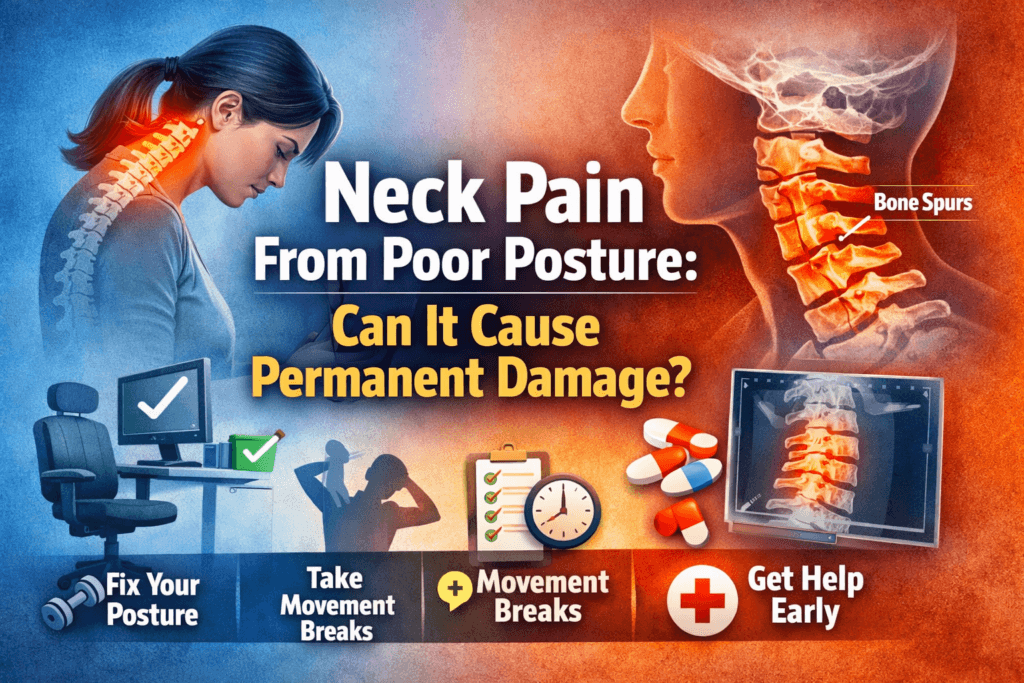
Neck Pain From Poor Posture: Can It Cause Permanent Damage? 11 Expert Insights
Neck pain rarely appears without a reason, for most people, it develops slowly through everyday habits that seem harmless at the time. Hours spent leaning over phones, working on laptops, or sitting with rounded shoulders place constant strain on the cervical spine, what starts as mild stiffness often turns into recurring pain that refuses to fully go away.
This leads to an important and uncomfortable question, if posture caused the pain, could it also be causing permanent damage?
The concern is valid, but the reality is more nuanced, poor posture alone does not usually cause sudden or irreversible neck injury. However, when poor positioning becomes a daily pattern for years, it can contribute to structural stress, nerve irritation, chronic pain, and long term functional limitations if nothing is done.
Understanding how posture affects the neck is the difference between fear and control, this article breaks down what posture actually does to the cervical spine, which changes are reversible, which may become permanent, and how to protect your neck before a temporary problem turns chronic.
Understanding Neck Anatomy and Posture
The neck, medically known as the cervical spine, is a complex structure designed for both stability and mobility. It consists of seven vertebrae, labeled C1 through C7, which support the weight of the head while allowing a wide range of motion including rotation, flexion, extension, and side bending.
Between each vertebra sits an intervertebral disc, these discs act as shock absorbers, distributing forces generated by movement and load. They also allow the neck to remain flexible rather than rigid, surrounding the vertebrae and discs are layers of muscles, ligaments, and tendons that work together to stabilize the spine and control precise movements.
In a neutral posture, the head is positioned directly over the shoulders, this alignment maintains the natural cervical curve, often described as a gentle inward arc. When this curve is preserved, mechanical load is distributed evenly across the vertebrae, discs, joints, and muscles. No single structure is forced to carry more stress than it was designed to handle.
Poor posture disrupts this balance, when the head moves forward, even by a few centimeters, the biomechanics of the cervical spine change significantly. The farther the head drifts in front of the shoulders, the more force is required to hold it upright. A head that weighs roughly 10 to 12 pounds in neutral alignment can impose more than 40 pounds of force on the cervical spine when tilted forward.
This constant overload does not cause immediate injury, but it creates sustained mechanical stress. Over time, tissues that are not designed for continuous strain begin to fatigue, leading to pain, stiffness, and reduced function. This is where posture related neck problems begin to develop.
What Is Poor Neck Posture?
Poor neck posture is often misunderstood, it is not limited to obvious slouching or visibly poor sitting positions. Many people with posture related neck pain appear to be sitting normally while still placing excessive stress on the cervical spine.
Forward head posture is the most common issue, it occurs when the head sits in front of the shoulders rather than directly above them. This position dramatically increases the load on neck muscles and joints and is especially common during prolonged phone and computer use.
Rounded shoulders often accompany forward head posture. When the shoulders roll forward, the upper back becomes more curved. The neck then compensates by pushing the head forward to maintain a level gaze, this compensation further increases cervical strain.
Prolonged neck flexion occurs when the head remains tilted downward for extended periods, such as when reading on a phone, using a laptop, or performing detailed tasks. Even if the posture feels comfortable in the moment, sustained flexion significantly increases disc and joint stress.
Asymmetrical posture places uneven load on the neck, common examples include leaning to one side while sitting, holding a phone between the ear and shoulder, carrying bags on one side, or sleeping in awkward positions that force the neck into rotation or side bending.
These postures often feel harmless because discomfort develops gradually. Over time, however, they alter how muscles activate and how joints absorb force. What begins as a positional habit can evolve into a mechanical dysfunction.
How Poor Posture Causes Neck Pain
Poor posture leads to neck pain through predictable and well documented mechanisms. These mechanisms do not act in isolation, they often occur together, reinforcing each other over time.
1. Muscle Overuse and Imbalance
When the head shifts forward, certain muscles must work continuously to prevent it from falling further. The upper trapezius, levator scapulae, and suboccipital muscles become chronically overactive, these muscles are not designed for constant low level contraction, so they tighten, fatigue, and develop painful trigger points.
At the same time, the deep neck flexor muscles, which play a key role in stabilizing the cervical spine, become underused and weak because these muscles are not functioning properly, the neck loses efficient support.
This imbalance creates a cycle of stiffness, muscle fatigue, reduced endurance, and aching pain that worsens with prolonged sitting or device use.
2. Joint Compression
Forward head posture increases compressive forces on the cervical facet joints. These small joints guide motion between vertebrae and help control spinal movement.
Excess compression irritates the joint surfaces and surrounding tissues. Over time, this can lead to inflammation, joint stiffness, reduced range of motion, and pain that is often felt deep in the neck, especially with extension or rotation.
3. Disc Stress
Sustained poor posture alters how pressure is distributed across cervical discs. Instead of being evenly loaded, certain areas of the disc experience greater stress.
This does not usually result in sudden disc herniation. Instead, it contributes to gradual disc dehydration, reduced shock absorption, and accelerated wear, these changes increase the likelihood of disc related pain and stiffness over time.
4. Nerve Irritation
Tight muscles, inflamed joints, or disc changes can reduce the space through which cervical nerves travel. When these nerves become irritated, pain may radiate beyond the neck. Symptoms can include pain spreading into the shoulders, upper back, or arms, as well as tingling, numbness, or burning sensations. These symptoms indicate that posture is affecting not only muscles and joints but also neural structures.
Can Poor Posture Cause Permanent Neck Damage?
This is where honesty matters, poor posture does not suddenly destroy the neck. The human cervical spine is resilient, adaptable, and designed to tolerate a wide range of loads. Short periods of bad posture or occasional slouching do not cause permanent harm.
The problem is not posture in isolation, the problem is duration. When poor posture becomes a daily pattern over months or years, it creates sustained mechanical stress, that stress can contribute to structural and functional changes that become harder to reverse with time.
Whether permanent damage occurs depends on several factors, these include how long poor posture has been present, how severe the postural deviation is, genetic predisposition, age, overall activity level, and most importantly, whether corrective action is taken early. To understand this clearly, it helps to separate reversible changes from those that may become long term.
Changes That Are Usually Reversible
Many posture related neck problems respond very well to early intervention. In these cases, pain is driven more by muscle dysfunction and mechanical stress than by structural damage.
1. Muscle Tightness and Weakness
Muscle imbalances caused by poor posture are among the most reversible contributors to neck pain. Chronically tight muscles can be lengthened, and underactive muscles can be strengthened through targeted exercise.
When muscle balance is restored, load distribution across the cervical spine improves. Pain often decreases significantly, sometimes resolving completely.
2. Postural Pain Without Structural Damage
If imaging shows no meaningful disc degeneration, arthritis, or nerve compression, posture correction often leads to near full or full recovery. In these cases, pain is mechanical rather than pathological, improving alignment, movement patterns, and muscle control allows irritated tissues to calm down and heal.
3. Mild Joint Stiffness
Joint stiffness caused by prolonged static positioning is rarely permanent. Restoring movement through regular activity, manual therapy, and ergonomic changes often improves mobility and reduces discomfort.
For most people who develop neck pain from desk work, phone use, or prolonged sitting, these reversible factors account for the majority of symptoms.
Changes That Can Become Long Term or Permanent
Problems arise when poor posture persists for years without correction. Over time, the body adapts to abnormal loading in ways that may not fully reverse.
1. Degenerative Disc Changes
Chronic abnormal stress can accelerate disc dehydration and thinning. Degenerative disc disease is not caused by posture alone, but poor posture can worsen its progression.
Once disc degeneration occurs, the structural changes are permanent. However, the presence of degeneration does not automatically mean pain, symptoms can often be managed effectively with proper care.
2. Cervical Osteoarthritis
Excessive and uneven joint loading may contribute to earlier development of facet joint osteoarthritis. This condition leads to stiffness, reduced range of motion, and pain that often worsens with certain movements.
Arthritic changes are permanent, but symptom severity varies widely. Many people with arthritis remain functional and comfortable with appropriate management.
3. Chronic Nerve Compression
If long term postural stress contributes to disc bulges, joint enlargement, or bone spur formation, cervical nerves may become compressed.
In these cases, neurological symptoms such as arm pain, numbness, or weakness may persist even after posture improves. Early treatment significantly reduces this risk.
4. Altered Spinal Curvature
Severe forward head posture maintained over long periods can alter cervical alignment. While posture can often be improved, full restoration of the original spinal curve may not always be possible.
This does not mean disability is inevitable. It means that correction becomes more challenging and may require ongoing management rather than a complete reset.
Is Tech Neck a Real Medical Problem?
Yes. Tech neck is not a marketing term or internet scare tactic, it describes a real and increasingly common pattern of neck pain, stiffness, headaches, and upper back discomfort associated with prolonged device use.
Research consistently shows that increased cervical flexion angles during smartphone use dramatically increase mechanical load on the neck. The more time spent in these positions, the greater the cumulative stress. That said, tech neck does not automatically lead to permanent damage, the risk increases with longer daily exposure, fewer movement breaks, weak postural muscles, and lack of corrective exercise.
The issue is not technology itself, the issue is sustained posture without movement, recovery, or strength to support the load.
Symptoms That Suggest Posture Related Neck Damage
Not all neck pain is the same. Certain symptoms strongly suggest that posture is a primary driver rather than injury, infection, or systemic disease.
Posture related neck pain often presents with persistent stiffness that worsens during prolonged sitting, screen use, or phone time. Pain typically improves with movement, stretching, or posture correction rather than rest alone. Common associated symptoms include tightness at the base of the skull, headaches that originate in the neck and radiate forward, discomfort across the shoulders and upper back, and a noticeable reduction in neck mobility, especially with rotation or extension.
These symptoms usually fluctuate with activity and positioning, which is a key clue that mechanics play a major role. Some symptoms, however, suggest more serious involvement and should not be ignored.
Pain that radiates into the arm, numbness or tingling in the hand or fingers, weakness or clumsiness in the hands, pain that worsens at night or does not change with position, loss of coordination, or balance problems may indicate nerve compression or spinal cord involvement.
These signs require proper medical evaluation rather than self management.
Can Good Posture Reverse Neck Damage?
Good posture alone is not a cure, it will not instantly eliminate pain or reverse established structural changes. However, it is the foundation upon which recovery is built.
Correct posture reduces abnormal mechanical load on the cervical spine, it allows muscles to work efficiently, decreases joint compression, and gives irritated tissues a chance to recover.
When posture correction is combined with targeted exercise, ergonomic adjustments, and regular movement breaks, many people experience significant pain reduction and improved function. Even in individuals with disc degeneration or cervical arthritis, improving posture often leads to fewer flare ups, better mobility, and improved quality of life. Structural changes may remain, but symptoms can be controlled.
Evidence Based Treatment for Posture Related Neck Pain
1. Physical Therapy
Physical therapy is one of the most effective interventions for posture related neck pain. A structured program focuses on correcting the underlying mechanical problems rather than chasing symptoms.
Key components typically include strengthening the deep neck flexors, improving scapular stability, stretching chronically tight muscles, restoring normal joint mobility, and training posture awareness during daily activities.
This is not generic stretching or passive treatment, it is targeted rehabilitation designed to restore function.
2. Ergonomic Correction
Workstation setup has a direct impact on neck load. Small changes can significantly reduce cumulative stress. Screens should be positioned at eye level, chairs should support a neutral spine, keyboards and mouse should sit at elbow height and feet should rest flat on the floor.
These adjustments do not fix posture on their own, but they prevent repeated strain throughout the day.
3. Activity Modification
Movement matters more than perfect posture., even ideal alignment becomes harmful when held too long.
Regular breaks are essential, standing, walking, or changing position every 30 to 45 minutes reduces tissue fatigue. Alternating tasks and avoiding prolonged downward gaze further decreases strain.
4. Pain Management
Short term use of heat, ice, or anti inflammatory measures can be helpful during flare ups. These strategies do not correct posture, but they reduce pain enough to allow participation in exercise and rehabilitation.
5. Lifestyle Factors
Sleep position, stress levels, physical activity, and overall conditioning influence neck health more than most people realize. Poor sleep and chronic stress increase muscle tension and pain sensitivity, making posture related problems harder to resolve.
What Does Not Work Long Term
This needs to be stated clearly, posture braces used alone do not fix posture. They encourage passive support and reduce the need for muscles to work, often leading to dependence.
Massage therapy alone provides temporary relief but does not correct the mechanical causes of pain. Painkillers may reduce symptoms but do nothing to prevent progression or recurrence, quick fixes are appealing they fail because they do not address the underlying problem.
When to See a Doctor
Medical evaluation is appropriate when neck pain persists longer than six weeks despite posture correction and exercise, when neurological symptoms appear, when pain is severe or progressively worsening, or when there is a history of trauma.
Symptoms that interfere with daily function should also be assessed, imaging is not always necessary, but a proper clinical examination helps rule out serious causes and guide appropriate treatment.
Can Poor Posture Cause Disability?
In rare cases, yes. Not because posture itself is inherently dangerous, but because years of ignored symptoms, lack of treatment, and progressive degeneration can lead to significant impairment.
Most people who address posture related neck pain early never reach this stage, fear based thinking does not help, consistent action does.
The Bottom Line
Neck pain caused by poor posture is common, but permanent damage is not the default outcome. The cervical spine does not fail suddenly, it adapts to repeated stress over time, for better or worse.
Early posture related changes are largely reversible, muscles respond to training, joints respond to movement, and pain often improves when mechanical stress is reduced. The real risk comes from long term neglect. Years of uncorrected poor posture can contribute to degenerative changes that cannot be undone, but can usually be managed.
The spine is resilient, not fragile. It reflects daily habits more than isolated moments of bad posture.
Correct alignment, proper muscle strength, regular movement, and early response to symptoms dramatically reduce the likelihood of long term damage. Waiting, ignoring pain, or relying on temporary fixes is what turns a manageable mechanical problem into a chronic condition. Your neck is not breaking down without reason, it is responding exactly to how it has been used.
👩⚕️ Need Personalized Health Advice?
Get expert guidance tailored to your unique health concerns through MuseCare Consult. Our licensed doctors are here to help you understand your symptoms, medications, and lab results—confidentially and affordably.
👉 Book a MuseCare Consult NowMust Read:
- Top 10 Proven Neck Pain Causes, Symptoms and Treatment Options That Actually Work
- 12 Proven Ways Neck Pain Causes Headaches (and How to Stop Them)
- 14 Proven Causes of Neck Pain That Comes and Goes (What to Do About It)
- Neck Pain From Sleeping Position or Pillow Choice: 13 Proven Solutions for Morning Pain Relief
- Best Back and Joint Pain Relief Devices You Can Use at Home: 17 Doctor‑Approved Solutions That Work
- Degenerative Disc Disease: 10 Powerful Reasons Back Pain Worsens With Age

Dr. Ijasusi Bamidele, MBBS (Binzhou Medical University, China), is a medical doctor with 5 years of clinical experience and founder of MyMedicalMuse.com, a subsidiary of Delimann Limited. As a health content writer for audiences in the USA, Canada, and Europe, Dr. Ijasusi helps readers understand complex health conditions, recognize why they have certain symptoms, and apply practical lifestyle modifications to improve well-being