
⚠️ Affiliate Disclaimer: This post may contain affiliate links, which means I may earn a small commission — at no extra cost to you — if you make a purchase through one of these links. I only recommend products or services I genuinely trust and believe can provide value. Thank you for supporting My Medical Muse!
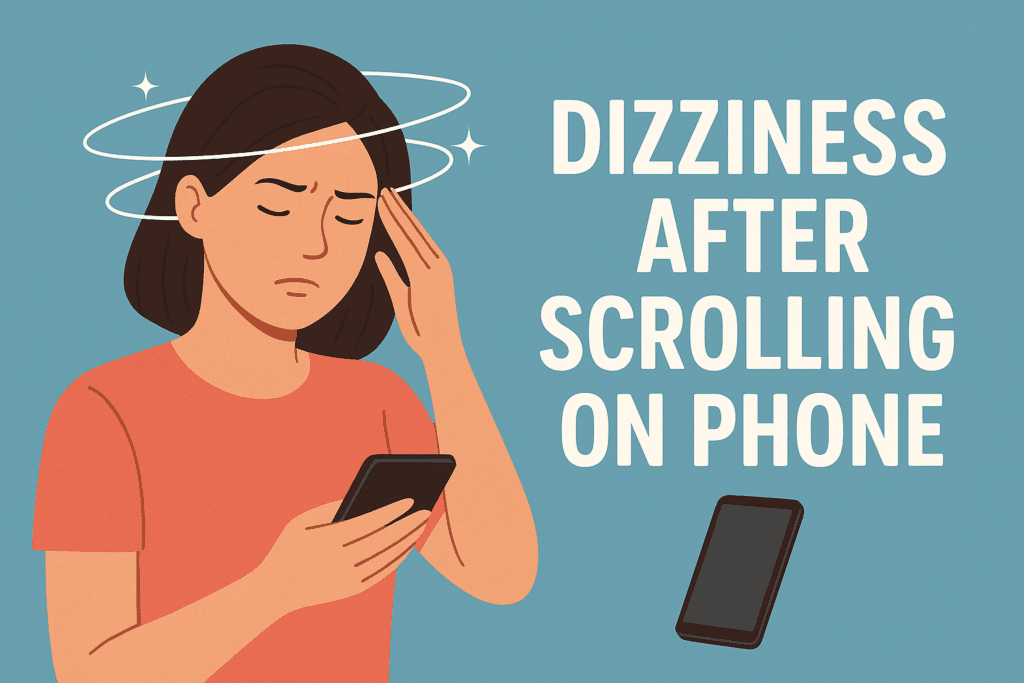
Dizziness After Scrolling on Phone: 7 Powerful Ways to Stop Feeling Off‑Balance
Ever put down your phone and suddenly feel like the room is swaying? That disorienting, lightheaded sensation after scrolling isn’t just in your head, it’s a real response your body has to prolonged screen use. In our hyper-connected world, these moments of dizziness are more common than you might think.
What triggers this sensation? How do your eyes, brain and inner ear interact to create that off-balance feeling? More importantly, what can you do to prevent it from ruining your day?
In this article, we’ll explore the science behind phone-induced dizziness, uncover common triggers and share practical strategies to stay steady while staying connected.
What Dizziness After Scrolling Feels Like
People describe this sensation differently:
- Feeling off balance or floaty.
- Lightheadedness or mild vertigo.
- Nausea or queasiness.
- A brief spinning or tilting sensation when looking away from the phone.
- A sense of motion even though you’re sitting still.
It can last a few seconds or linger for minutes. Some people also experience headaches, eyestrain, or blurred vision alongside the dizziness. If this sounds familiar, you’re not alone and it’s not necessarily a sign of serious illness. It’s often linked to how your sensory systems respond to prolonged screen use.
The Science Behind Screen-Induced Dizziness
To understand why scrolling can make you dizzy, it helps to look at how your body maintains balance. Your vestibular system, located in the inner ear, works with your eyes and brain to detect motion and orientation. Normally, what you see aligns with what your body feels, when you walk forward, your eyes see movement and your inner ear senses acceleration, but when those signals don’t match, your brain gets confused and that confusion can cause dizziness or nausea.
When scrolling on a phone, that’s exactly what happens.
1. Sensory Conflict: Eyes vs. Inner Ear
When you scroll through videos, photos, or text, your eyes perceive movement, the screen is moving upward or downward.
But your body and inner ear sense that you’re sitting still.
This mismatch between your visual and vestibular input triggers a mild form of motion sickness, similar to what people feel on a boat or in a car.
Your brain interprets the conflicting signals as a potential problem, in ancient survival terms, such mismatched sensations might have meant poisoning (hence why nausea is part of the response). So your brain reacts with dizziness, queasiness, and a sense of disorientation.
This is called visual-vestibular mismatch or cybersickness.
2. Blue Light and Eye Strain
Most phone screens emit blue light, which can cause eye fatigue and disrupt normal focusing mechanisms. When you stare at a bright screen, close to your face for long periods, your eyes have to constantly adjust focus (a process called accommodation) and converge inward to track the scrolling content. Over time, this can tire the tiny muscles that control eye movement, leading to:
- Blurred vision
- Headache
- Dizziness
- A sensation of imbalance when you look away
This strain is sometimes referred to as digital eye strain or computer vision syndrome, and it’s common among people who spend hours on screens daily.
3. Visual Flow and Peripheral Disruption
Scrolling content creates a “visual flow”, continuous motion in your central vision while your peripheral vision remains static.
Your brain interprets this as movement in the environment, even though your body isn’t moving. This mismatch can cause temporary spatial disorientation, much like what happens in simulator sickness (a condition studied in pilots and gamers exposed to virtual reality).
The faster or smoother the scrolling, the stronger this effect tends to be especially with video-heavy apps like TikTok, Instagram Reels, or YouTube Shorts.
4. Poor Posture and Neck Tension
Most people look down at their phones with their neck bent forward, shoulders slouched, and head tilted. This posture can:
- Reduce blood flow to the brain
- Tense neck and shoulder muscles
- Compress nerves and arteries in the cervical region
Together, these can cause or worsen dizziness and lightheadedness. This is often called cervicogenic dizziness, dizziness that originates from neck strain. If you notice dizziness accompanied by neck pain or stiffness, posture may be the main culprit.
5. Dehydration and Fatigue
Spending hours scrolling without drinking water, resting your eyes, or getting up to move can also contribute. Dehydration reduces blood pressure and oxygen delivery to the brain, causing lightheadedness. Combined with visual strain, it can make the dizziness worse.
Add poor sleep or prolonged screen exposure into the mix, and your sensory system becomes even more sensitive.
Who’s More Likely to Experience It?
Anyone can feel dizzy after scrolling, but certain factors make it more likely:
- People prone to motion sickness (on boats, cars, or VR headsets)
- Those with migraines, especially vestibular migraines
- Individuals with inner ear or balance disorders (like benign paroxysmal positional vertigo, or BPPV)
- People with anxiety or panic tendencies, which can amplify dizziness sensations
- Children and teens, whose visual and vestibular systems are still developing
If you fall into one of these categories, you might be more sensitive to screen-induced dizziness.
Common Triggers
Let’s look at what everyday phone behaviors may be setting off that dizzy feeling.
1. Fast Scrolling or Auto-Play Content
Rapidly moving visuals like reels or TikTok videos, bombard your eyes with motion stimuli. The faster or more erratic the motion, the more intense the mismatch.
2. Low Ambient Lighting
Using your phone in a dark room increases contrast and makes your eyes work harder to adjust to the screen’s brightness.
3. Holding the Phone Too Close
Most people hold their phones just 8-12 inches away, forcing the eyes to maintain constant, tight focus.
4. Prolonged Use Without Breaks
Scrolling for hours fatigues both your visual and vestibular systems. Even short breaks (every 20-30 minutes) can reset your balance.
5. Sudden Screen Movement
Tilting, rotating, or shifting the phone abruptly while scrolling can add an extra layer of motion confusion.
When to Worry: Signs It Could Be Something More
Occasional dizziness after scrolling is usually harmless and goes away once you rest your eyes or take a break.
But persistent or severe dizziness could signal an underlying issue.
See a doctor if you experience:
- Recurrent or worsening dizziness unrelated to screen time
- Vertigo lasting more than a few minutes
- Hearing loss, ringing in the ears, or pressure
- Double vision or vision loss
- Nausea and vomiting that don’t subside
- Unexplained fatigue or confusion
These could point to vestibular disorders, migraines, or neurological issues that require professional evaluation.
How to Stop Feeling Dizzy After Scrolling
Fortunately, you don’t have to ditch your phone entirely. You just need to make your screen habits smarter.
Here are practical, science-backed steps to reduce or prevent dizziness after scrolling:
1. Follow the 20-20-20 Rule
Every 20 minutes, look at something 20 feet away for at least 20 seconds. This relaxes your eye muscles and resets your visual focus. You can even set a reminder app or use phone wellness settings to prompt you.
2. Adjust Brightness and Contrast
Avoid extremes.
- If your screen is too bright compared to your surroundings, it strains your eyes.
- If it’s too dim, your eyes work harder to see details.
Use auto-brightness or manually adjust your screen to match the ambient light.
3. Limit Scrolling Speed
Slow down your scrolling to minimize visual flow. When watching short-form videos, take pauses between clips instead of bingeing through endless auto-play content.
4. Maintain Proper Posture
Keep your phone at eye level instead of bending your neck down. Sit upright, shoulders back, with your head aligned over your spine. This reduces neck strain and improves blood flow to the brain.
5. Blink Often and Hydrate
People blink less when using screens, sometimes only 5-7 times per minute instead of the usual 15-20. This leads to dryness and fatigue.
Consciously blinking more, or using artificial tears if needed, can help.
Also, drink enough water throughout the day, dehydration intensifies dizziness.
6. Use Night Mode or Blue Light Filters
Blue light filtering apps or built-in “Night Shift” modes can reduce digital eye strain, especially during evening use. While the science on blue light and dizziness isn’t absolute, many users report less discomfort when using warmer tones.
7. Take Screen-Free Breaks
Give your sensory system time to recalibrate. Step away from your phone every hour. Walk around, stretch or look out a window, activities that engage your full visual field and re-establish balance.
8. Switch to Larger Screens for Long Reads
If you’re reading or watching long-form content, use a tablet or computer screen positioned at a comfortable distance instead of your small phone screen. This reduces the intensity of visual motion and minimizes head and eye movement.
9. Avoid Scrolling in Moving Vehicles
Your brain already struggles with motion signals while in a car, train, or plane. Adding screen movement increases the sensory conflict exponentially. If you must use your phone, try focusing on stationary text instead of fast-moving visuals.
10. Manage Stress and Fatigue
Anxiety and exhaustion make your nervous system more sensitive. Incorporate relaxation techniques like deep breathing, stretching, or short naps to stabilize your body’s response to sensory overload.
What If You Already Feel Dizzy?
If dizziness hits while scrolling, the key is to pause immediately and help your sensory system recalibrate. Don’t try to push through it, that can make symptoms worse. Instead, do the following:
- Put the phone down and look at a distant, stationary object, like a wall, tree or the horizon. Focusing on something stable helps your visual system re-anchor to the real-world environment, calming the motion signals in your brain.
- Close your eyes for 30-60 seconds and take slow, deep breaths. This reduces sensory input and activates your body’s relaxation response, helping to stabilize blood flow and ease the feeling of imbalance.
- Move your head gently from side to side or tilt it slowly up and down. These light vestibular resets can help your inner ear readjust to your body’s still position, especially if the dizziness came from visual-vestibular mismatch.
- Drink water or have a light snack if it’s been a while since you ate. Low blood sugar or dehydration can amplify dizziness and fatigue, even when the initial trigger is visual.
- Rest in a quiet, dimly lit space until the symptoms fade. Bright lights or continued visual motion can delay recovery.
- Lie down or recline slightly if you still feel lightheaded after several minutes. This reduces your body’s balance demands and stabilizes blood flow to the brain.
- Avoid going straight back to your screen. Give yourself at least 10-15 minutes of visual rest before using any digital device again. When you do resume, start with smaller doses, maybe respond to messages or read static content instead of fast-scrolling videos.
If dizziness lasts longer than a few minutes or if you experience accompanying symptoms like nausea, vision changes, or headache, take a longer break and consider discussing the issue with a healthcare provider.
Could It Be a Vestibular or Migraine Disorder?
In most cases, dizziness after scrolling is temporary and harmless but for some people, it’s a recurring symptom tied to an underlying vestibular or neurological condition. Recognizing these possibilities can help you take the right next steps.
1. Vestibular Migraine
A vestibular migraine is a type of migraine that primarily affects balance and spatial perception rather than producing head pain.
People with vestibular migraines may experience:
- Dizziness or vertigo that lasts from minutes to hours
- Sensitivity to light, sound, or motion
- Nausea and difficulty focusing visually
Screen use, especially exposure to bright lights, flickering or rapid motion can easily trigger or worsen these symptoms. Managing this type of migraine typically involves identifying triggers, maintaining regular sleep and meal patterns, limiting caffeine and sometimes using prescribed migraine medications.
2. Benign Paroxysmal Positional Vertigo (BPPV)
BPPV occurs when tiny calcium crystals (otoconia) in the inner ear move into areas where they shouldn’t be, sending false signals to your brain about your position and movement.
Though it’s usually triggered by changes in head position like lying down, looking up or rolling over, people with BPPV may find that rapid screen motion or frequent head tilting while scrolling can make the dizziness worse.
If you suspect BPPV, a healthcare provider can perform simple repositioning maneuvers (like the Epley maneuver) to move the crystals back where they belong. It’s an easy and highly effective treatment when done correctly.
3. Persistent Postural-Perceptual Dizziness (PPPD)
PPPD is a chronic condition in which the brain becomes hypersensitive to motion and visual stimuli. It often develops after an episode of vertigo, concussion or severe motion sickness, but persists long after the original trigger is gone.
People with PPPD often describe:
- Constant unsteadiness or rocking sensations
- Heightened sensitivity to visual motion (like scrolling feeds, moving traffic, or crowded stores)
- Symptoms that worsen with fatigue or stress
Treatment usually involves a combination of vestibular rehabilitation therapy, cognitive-behavioral therapy (CBT), and sometimes low-dose medications to calm the brain’s motion-processing pathways.
If you notice dizziness that continues for weeks or months and isn’t relieved by simple adjustments, it’s worth seeing a neurologist or vestibular specialist for assessment. Early diagnosis can prevent symptoms from becoming chronic.
Tech and App Design: A Hidden Factor
While physiology plays a major role, the digital environment itself is often overlooked as a contributor to screen-induced dizziness. The way most apps and interfaces are designed can subtly overstimulate your sensory system, especially your eyes and inner ear.
1. Infinite Scrolling and Auto-Play Features
Many social platforms (like TikTok, Instagram, and X) use infinite scroll and auto-play to keep users engaged. These constant transitions create an uninterrupted stream of motion that your eyes follow but your body doesn’t. This visually dynamic experience, where new content slides up every second triggers the same sensory conflict that causes motion sickness. The more seamlessly the app moves, the more your brain struggles to anchor itself to a stable frame of reference.
2. Parallax Effects and Animated Transitions
Modern apps and websites often use parallax effects (where background and foreground elements move at different speeds) to create depth and immersion. While aesthetically pleasing, these animations can lead to visual overstimulation, especially in sensitive users. The brain interprets these subtle motion cues as environmental movement, which confuses the vestibular system and triggers dizziness, nausea, or mild vertigo.
3. High Refresh Rates and Screen Flicker
Phones with high refresh rates (90Hz, 120Hz, or above) produce smoother scrolling, but for some users, that very smoothness can increase motion sensitivity. Additionally, screen flicker from pulse-width modulation (PWM) in OLED displays can cause eyestrain and dizziness even when it’s imperceptible.
If you notice symptoms only with specific devices, you might be sensitive to PWM flicker or high-motion rendering. Switching to a phone with DC dimming, eye comfort mode, or lower refresh rate options may help.
4. App Interface Design
Visual clutter like moving backgrounds, transitions and pop-up notifications also taxes your sensory system. Each animated element demands processing power from your brain, creating micro-conflicts between what your eyes see and what your body feels.
Some users experience improvement when switching to “lite” versions of apps (for example, Facebook Lite, YouTube Lite, or X Lite), which strip away heavy animations and background transitions. Others prefer using social platforms through mobile browsers, which typically disable continuous auto-play.
5. Accessibility Settings to Reduce Motion
If you’re sensitive to visual motion, explore the accessibility settings on your smartphone. Both iOS and Android allow you to:
- Reduce motion (disables parallax and transition animations)
- Turn off auto-play videos
- Limit visual effects in menus and backgrounds
- Activate dark mode, which reduces visual glare and contrast fatigue
These small tweaks can make a surprisingly large difference in your comfort and reduce dizziness dramatically, especially during long browsing sessions,
Long-Term Eye and Brain Adaptation
The human body is adaptable. Some studies suggest that with gradual exposure, your brain can adjust to repetitive screen motion and reduce dizziness over time, a process called habituation.
However, this doesn’t mean you should power through discomfort. Overexposure without rest can worsen symptoms and lead to chronic eye strain. Think of it like exercise, consistent but moderate use builds tolerance, while overuse leads to fatigue and injury.
Conclusion
It’s easy to underestimate how much a simple habit, scrolling on your phone can throw your body’s balance off. Yet that mild dizziness is your brain’s way of saying Slow down. What feels like a random spell of lightheadedness often comes from sensory overload, visual fatigue or posture strain.
The fix isn’t to quit your phone entirely, it’s to use it smarter. Simple changes like maintaining proper posture, looking away periodically, adjusting screen settings and slowing your scroll can make a real difference. Small shifts in awareness often restore stability faster than you’d expect.
If your dizziness persists, don’t ignore it. Your body’s balance system is sensitive for a reason, paying attention to those dizzy spells might not just save you from discomfort, it could reveal something deeper about how your brain and body interact in our hyper-digital age.
👩⚕️ Need Personalized Health Advice?
Get expert guidance tailored to your unique health concerns through MuseCare Consult. Our licensed doctors are here to help you understand your symptoms, medications, and lab results—confidentially and affordably.
👉 Book a MuseCare Consult NowExplore More:
- Why You Feel Dizzy When You Get Angry: 5 Hidden Body Reactions
- 10 Powerful Reasons Why You Get Dizzy Right Before Your Period
- Why Do I Get Dizzy and Nauseous in the Shower? 7 Powerful Causes & Fixes
- Why You Feel Dizzy After Skipping a Meal: 10 Urgent Reasons (and What to Do)
- 13 Powerful Causes of Random Chest Tightness That Goes Away on Its Own

Dr. Ijasusi Bamidele, MBBS (Binzhou Medical University, China), is a medical doctor with 5 years of clinical experience and founder of MyMedicalMuse.com, a subsidiary of Delimann Limited. As a health content writer for audiences in the USA, Canada, and Europe, Dr. Ijasusi helps readers understand complex health conditions, recognize why they have certain symptoms, and apply practical lifestyle modifications to improve well-being